

The most common mistakes in fish treatment: Ivo Barteček advises what (not) to do when a disease appears in the aquarium
The treatment of aquarium fish is not just about adding a universal remedy to the water. It requires patience, accurate diagnosis, and knowledge of the ecosystem. Ivo Barteček, an expert with many years of experience, discusses in this guide the most common mistakes made by beginners and advanced aquarists alike, and shows that the path to a healthy aquarium goes through prevention and a proper understanding of biological processes.
Do you have troubles in your aquarium? We are launching a new advisory service for aquarists!
The health of fish is a priority for every aquarist, but the diagnosis is not always clear at first glance. Therefore, we have prepared a new section where we will address your specific questions and problems with diseases in aquariums together with experts. The first to contact us was an aquarist asking for the identification of a white spot on a neon tetra, which did not respond to common treatments. If you are also struggling with an unknown parasite or sick fish, do not hesitate to send us a description of the problem along with photographs to the email info@foraquarist.com.
Reader's inquiry: Unknown white spot on a neon tetra
Subject: Request for identification of parasite – white spot on neon tetra (it is not ich)
Good day,
I would need help with identifying a parasite that has appeared in my aquarium. I have it on one neon tetra – it looks like a white spot (see attached photos).
I would like to emphasize that it is not ich (Ichthyophthirius multifiliis). The treatments with eSHa 2000 and eSHa Exit are not effective, and the condition is not changing.
Does anyone have experience with what it could be and how to get rid of it?
Thank you in advance for your advice.
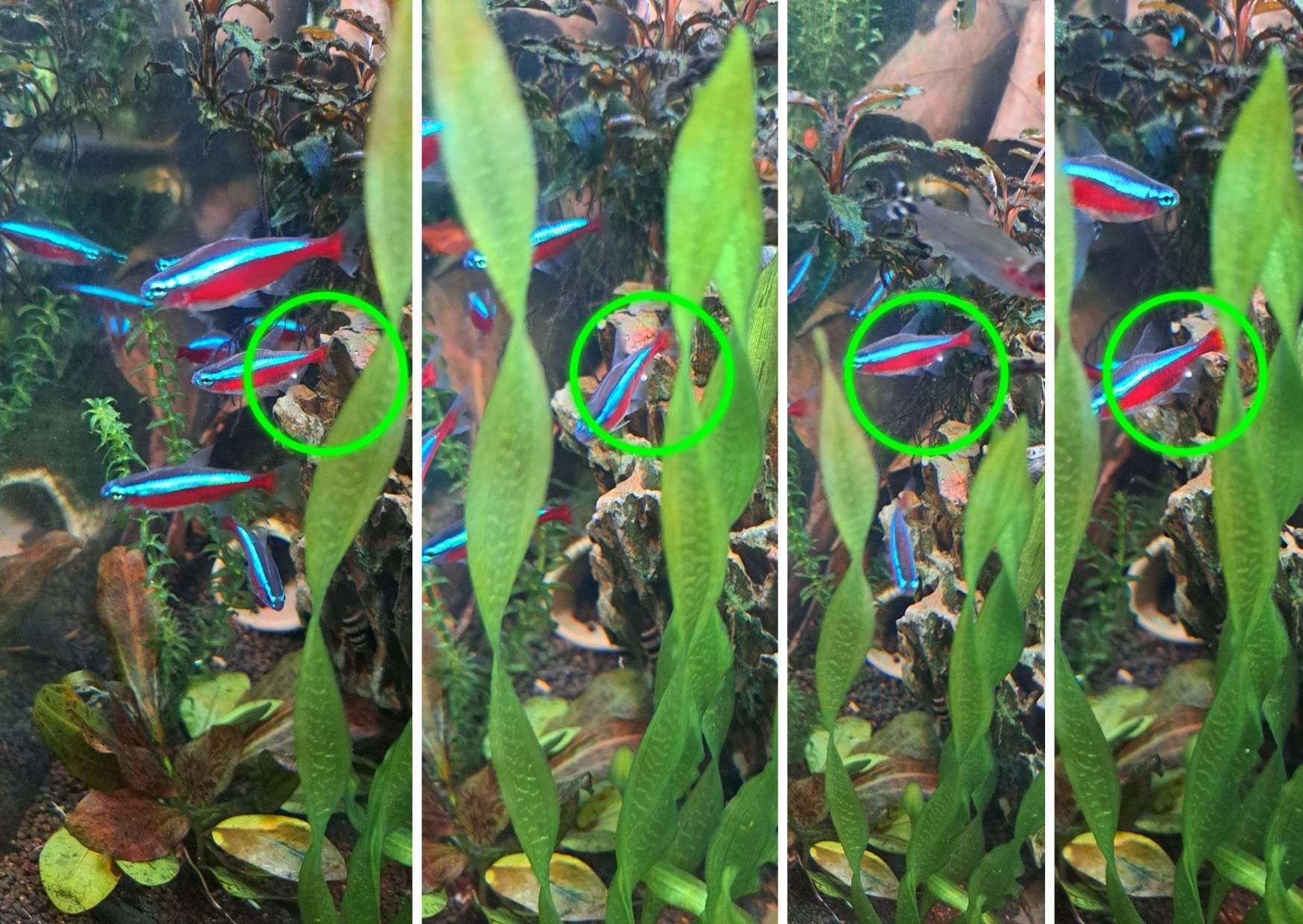
The aquarist contacted us regarding an unknown parasite
Response by Ivo Barteček:
Based on the submitted photographs, it could be several types of diseases – from microsporidian infections to bacterial infections and even viral conditions (for example, lymphocystis). Unfortunately, a precise diagnosis could only be established based on a professional microbiological examination.
However, we must prepare you for the fact that these particular diseases are unfortunately practically untreatable with commonly available medications. We understand that this is unpleasant news, but in the interest of protecting the other fish in the aquarium, it is necessary to proceed with caution:
Prevention of spreading: In the case of common fish species, the most responsible and merciful solution is gentle euthanasia, which will prevent further transmission of the disease.
Isolation: If it concerns rare or valuable specimens, their immediate isolation in a quarantine tank with very strict hygiene adherence is essential.