
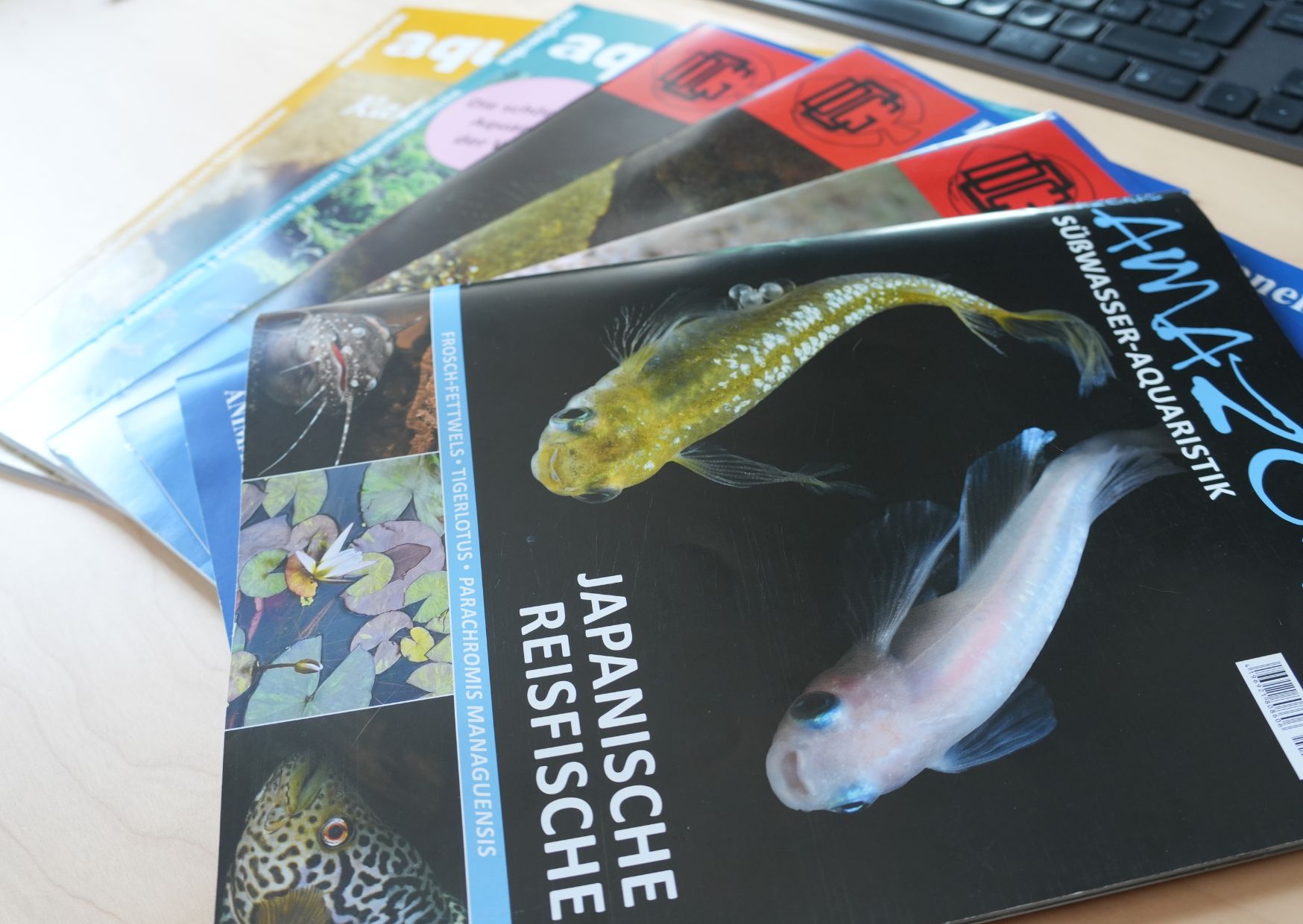
We bring you a selection from leading German aquaristic magazines. What has been stirring the world of aquaristics at the beginning of the year? We would like to offer at least a brief overview to those who do not have the opportunity to follow foreign press in a foreign language. And if any of the topics catch your interest, you can then look up and purchase the respective issue yourself.
Japanese ricefish in the magazine Amazonas
🌏 Issue Theme: Japanese Ricefish (Oryzias)
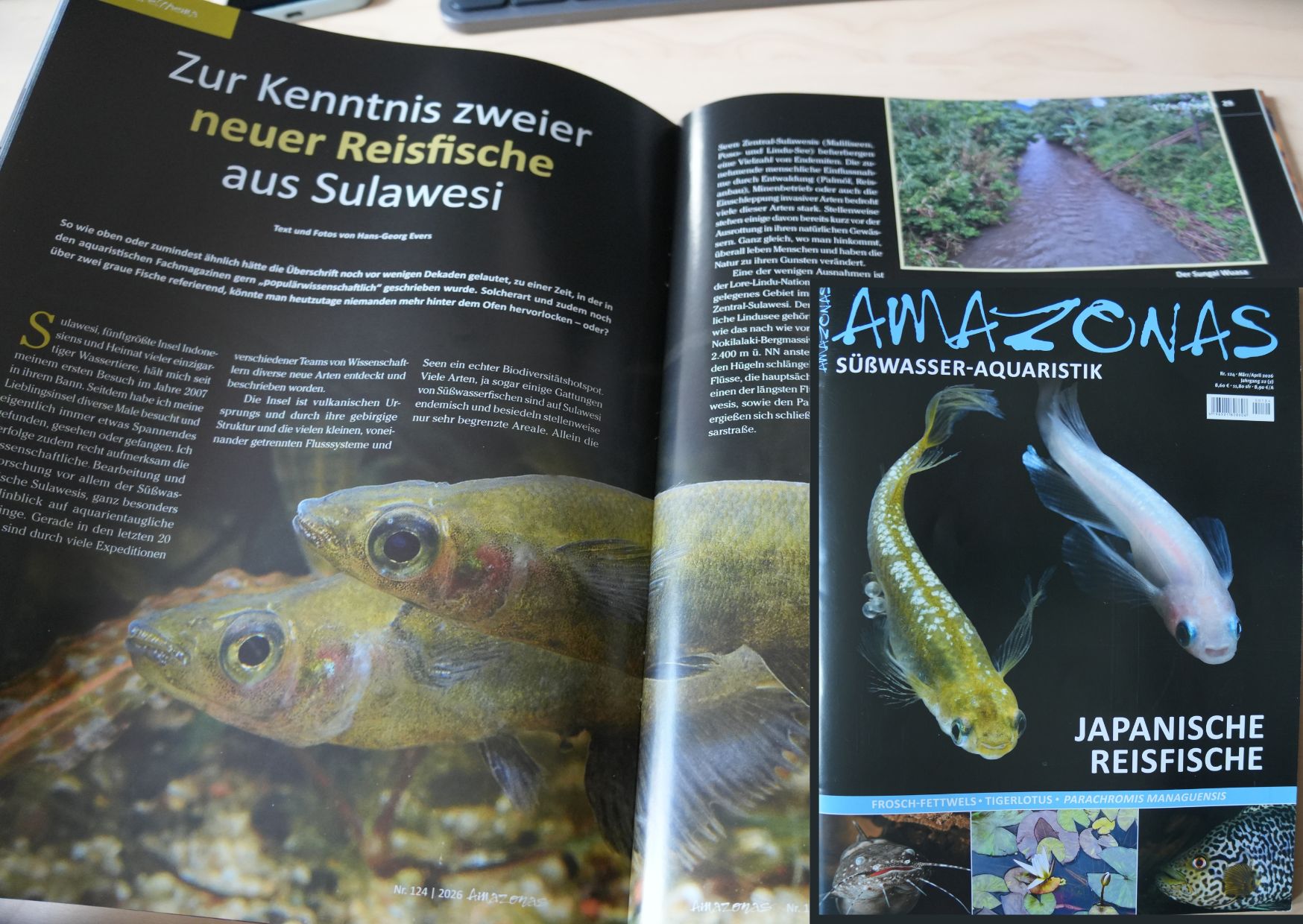
The spring issue of the magazine Amazonas is dedicated to ricefish, specifically Japanese ricefish. You can't miss the main theme on the cover, and inside, readers can expect approximately 25 pages of stunning photographs and interesting information.
In Japan, ricefish are a common part of culture, and it is therefore good that Friedrich Bitter (1) at least briefly addresses their history and basic classification in the introduction to his text. Ricefish are no longer just fish for small ponds or containers where they were supposed to help with the elimination of hatching insects. The world of color forms and breeding is evolving incredibly quickly, and what is currently trendy in Europe is often already an outdated trend in Japan.
Exclusive color variants of ricefish appear at auctions, where they fetch extraordinarily high prices. Therefore, there are specialized breeding farms, farms, and shops in Japan focused specifically on ricefish. The article also addresses their breeding. Regarding breeding, it points out that there is no universal recipe. Each breeder must find their own proven path.
Following Friedrich Bitter's extensive text on the next page is an article that may not surprise experienced readers as much, but is still worth attention. Hans-Georg Evers (2) adds his article on the species of "ricefish." One of them bears his name (the so-called Epiteton honorificum) Oryzias eversi while another species Oryzias celebensis refers to the island from which it originates. Notably, five species of the genus Oryzias have been described in the last four years. One of them is an endemic from the central part of Sulawesi, Oryzias hadiatyae, named in honor of the late renowned Indonesian ichthyologist Renny Kurnii Hadiaty.
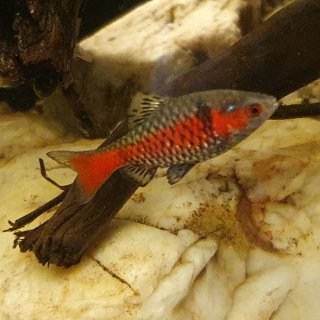
The most remarkable species of "ricefish" that Hans-Georg Evers has encountered so far is Oryzias kalimpaaensis.This fish lives in a small lake Kalimpaa at an altitude of an incredible 1,600 m. Hans-Georg Evers also describes its breeding in his home Hamburg aquarium. According to the author, the fish are thriving, have completely lost their shyness, accept practically any food, and eat very eagerly. One of the larger males grew to seven centimeters, which is relatively considerable for a representative of such a small genus. Although the males exhibit beautiful dark coloration, they immediately fade when the camera gets close. The article then goes into detail about their breeding.
The last species from this newly discovered quintet is Oryzias polylepis. As the name itself suggests, it is a "many-scaled" species, which is also relatively distinct from Oryzias kalimpaaensis. It occurs in a small lake near the locality where Oryzias kalimpaaensis was found, thus representing another micro-endemic. It was described only recently, in 2025.
🌿 Plants: Tiger Lotus as a Filter (3)
Spring is not only about new fish but also about aquatic plants. Rudolf Sutter focuses on the origin and systematics of the species Nymphaea lotus. Since the author has visited Africa himself, he brings an interesting perspective on the natural conditions in which two natural forms of this plant - red and green - thrive. He also describes other plants found in the presence of tiger lotus in the biotopes of Cameroon.
Sutter is evidently fascinated by the significant role that Nymphaea lotus can play in an aquarium, practically labeling it as a biological filter. He supports his claims with detailed explanations of the relevant processes.
It is also interesting to mention that lotuses can form three different types of rhizomes: horizontally growing, possibly creeping; vertically growing, where long petioles of leaves and flower stems point towards the surface; and elongated tuberous parts on the bottom, which are also processed in exotic cuisine. The entire article thus presents a pleasant and clear recap for all interested in this beautiful and useful plant.
Other articles worth noting:
- Roland Schreiber: Batrochoglanis raninus, "Fettwell's frog catfish"
- Ralf Britz: Sinobdella, an unusual genus of spiny-finned eel-like fish
- Jan Fioole: Parachromis managuensis, an impressive and mostly peaceful giant
Focused on Catfish
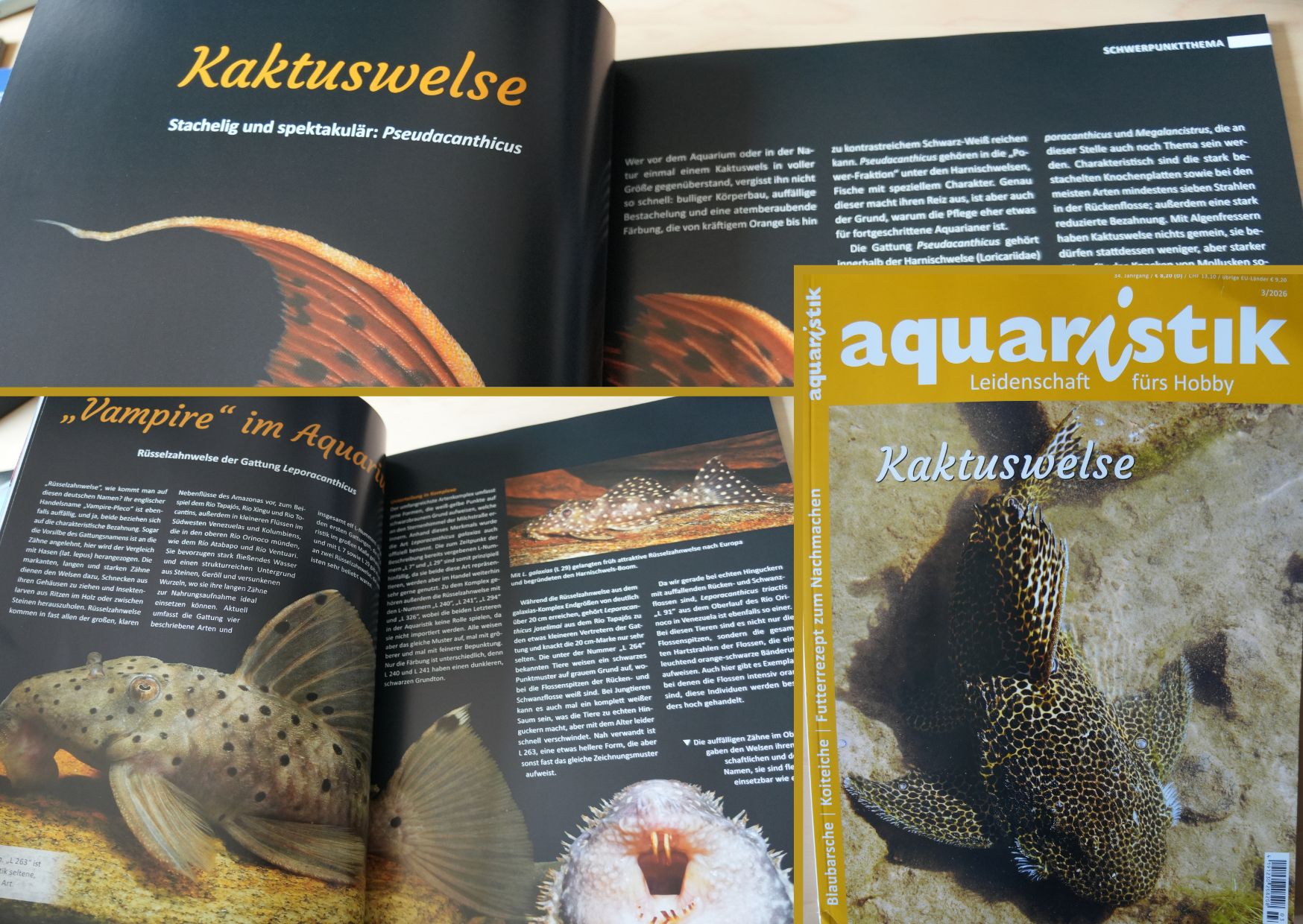
Editor-in-chief of the magazine Daniel Konn-Vetterlein admits in his introduction that the main theme of issue 3/2026 of Aquaristik is very close to him. The main theme of the issue, a total of 16 pages, is dedicated to catfish. Markus Kaluza further illustrates the articles with beautiful detailed photographs.
Fascination Pseudacanthicus & Leporacanthicus: "Cacti" and "Vampires" in the Aquarium
This article provides a detailed introduction to two of the most charismatic groups of armored catfish (Loricariidae) – the genera Pseudacanthicus (the so-called cactus catfish) and Leporacanthicus (vampire pleco). Author Markus Kaluza guides us through the world of these "power-fishes" from the Amazon, Orinoco, and other South American rivers, emphasizing their specific biological requirements and social husbandry.
Key points of the article:
- Taxonomy and morphology: Analysis of characteristic features, such as strong odontodes (a biological term for small, hard tooth-like structures) in the genus Pseudacanthicus and a unique dentition adapted for hunting invertebrates in the genus Leporacanthicus.
- Aquarium breeding: For successful breeding, a sufficient tank length (min. 150 cm), strong water currents, high oxygen content, and a temperature between 26 and 30 °C are essential. The article highlights the territoriality of adult individuals and the necessity of a structured interior with hiding places.
- Nutritional requirements: Unlike common "herbivores," these are carnivorous or omnivorous species with a strong preference for animal proteins (mollusks, insect larvae, shrimp).
- Breeding and reproduction: A detailed look at the stimulation of spawning (changes in pH, drop in pressure) and the demanding care of fry. The author shares experiences with the aggression of young fish and the critical phase in the development of larvae after the absorption of the yolk sac.
- Overview of species: Presentation of popular L-forms, such as L 24, L 25, L 114 (Pseudacanthicus) or L 29, L 91, and L 264 (Leporacanthicus).
The article offers a comprehensive view for advanced aquarists who want to understand the dynamics of these majestic fish and contribute to their sustainable breeding in the hobby.
🌱 Health and Nutrition: "Vacuum Freeze-Drying" (GVG) (9)
Author Dieter Untergasser often speaks about nutrition and its importance for aquatic organisms in his lectures. The same applies to the article in the March issue.
Proper nutrition is not just a matter of saturation in aquaristics, but a fundamental pillar of disease prevention and longevity of fish. The article focuses on critical differences between various forms of feed and warns against the consequences of inappropriate diets. The main points of the article:
1. Legal and ethical dimension: The Animal Protection Act also applies to "lower" creatures such as corals, sea anemones, insects, crustaceans, and fish. The breeder has a legal obligation to provide animals with appropriate nutrition and avoid causing pain or health damage due to poor feeding.
2. Risks of hidden carbohydrates: In many common dry feeds, the carbohydrate content is too high (often over 40%). This leads to liver fattening and bodily cavities. For most aquarium fish, the carbohydrate content should be below 25%, while it is essential to supplement the diet with fiber for proper digestion.
3. Comparison of feed forms: Live vs. frozen vs. GVG (Gefrier-Vakuum-Getrocknet)
- Live feed remains the most valuable source due to the content of intestinal contents of prey and active digestive enzymes.
- Frozen feed: The freezing process creates ice crystals that damage cellular structures. During thawing, vitamins and important nutrients leach into the water.
- GVG (Vacuum Freeze-Drying): This method (lyophilization) represents a top alternative. Due to the sublimation of ice at low temperatures, cells remain intact. The feed retains up to 95% of the nutritional value of the live organism, is sterile, and safe regarding pathogens.
4. Prevention as a goal: A deficiency of vitamins (e.g., vitamin C) and minerals leads to skeletal deformities and weakened immune systems. The author recommends combining high-quality dry feed with a daily dose of feed rich in fiber (Artemia, Daphnia) and lyophilized (GVG) components.
A varied diet that respects the biological needs of the specific species is the most effective remedy. Investing in quality feed with a careful processing method (GVG) will pay off for breeders in the form of healthy, vital, and vividly colored fish without the need for frequent medication.
🐟 KOI Section: The Pond is Not a Slave (10)
Breeding koi carp is often perceived as a time-consuming and technically complex hobby. Martin Kammerer (Konishi Europe GmbH) explains in an interview that the key to success is not "enslaving" the pond, but understanding the pond as a closed biological system that requires the right technological and methodological impulses.
1. Technology
A common mistake among beginners is undersized filtration, which leads to an endless cycle of cleaning and maintenance.
- Modern filtration: Automatic systems (drum or paper filters) remove impurities from the water before they start to decompose. This reduces maintenance requirements to virtually zero.
- Current and UV: Targeted currents direct impurities to the filters, and powerful UV lamps ensure clear water without algae.
In the interview, Martin Kramer points out that if the owner becomes a "slave" to their pond, the cause is always a flaw in the original plan or underestimating the technology.
2. Feeding
Feed is not just nutrition but the most important factor influencing water quality.
- Biological rhythm: Koi do not have a stomach, so feed passes directly into the intestines. For this reason, it is essential to feed multiple times a day in small portions.
- Temperature influence: At temperatures above 20 °C, fish require more energy (4–5 feedings per day). However, above 27 °C, it is necessary to reduce portions due to decreasing oxygen availability in the water.
Cheap feed increases the load on filters and worsens the vitality of fish. Quality feed is an investment in the stability of the entire system.
3. Preventing Stress and Microbiome
The most challenging aspect is recognizing whether koi are content in their conditions. They have the ability to mask stress. A fish may appear calm and eat, even when internally suffering from high levels of nitrogenous substances.
- Water exchange: The closed system of the pond naturally accumulates waste materials. Regular water changes (in summer 20-25% weekly) are the most effective way to relieve the invisible pressure on the fish's organism.
- Healthy microbiome: Fighting all bacteria is a mistake. The goal is to build a diverse, stable microbiome that strengthens the fish's immune system. Contact with "friendly" bacteria keeps the fish vital.
4. Genetics and Breeding Evolution
In the last 20 years, breeding in Japan has made a tremendous leap. Today's koi have more stable colors, better body structure, and more pronounced pigmentation. However, quality genetics require appropriate conditions; without top-notch care, the potential of top lines fades away.
A successful pond for koi is not about show effects but predictability. Those who regularly measure water parameters, monitor currents, and care for the microbiome will avoid sudden instabilities and diseases. The art is not to treat when illness or suffering is visible but to prevent it before it arises.
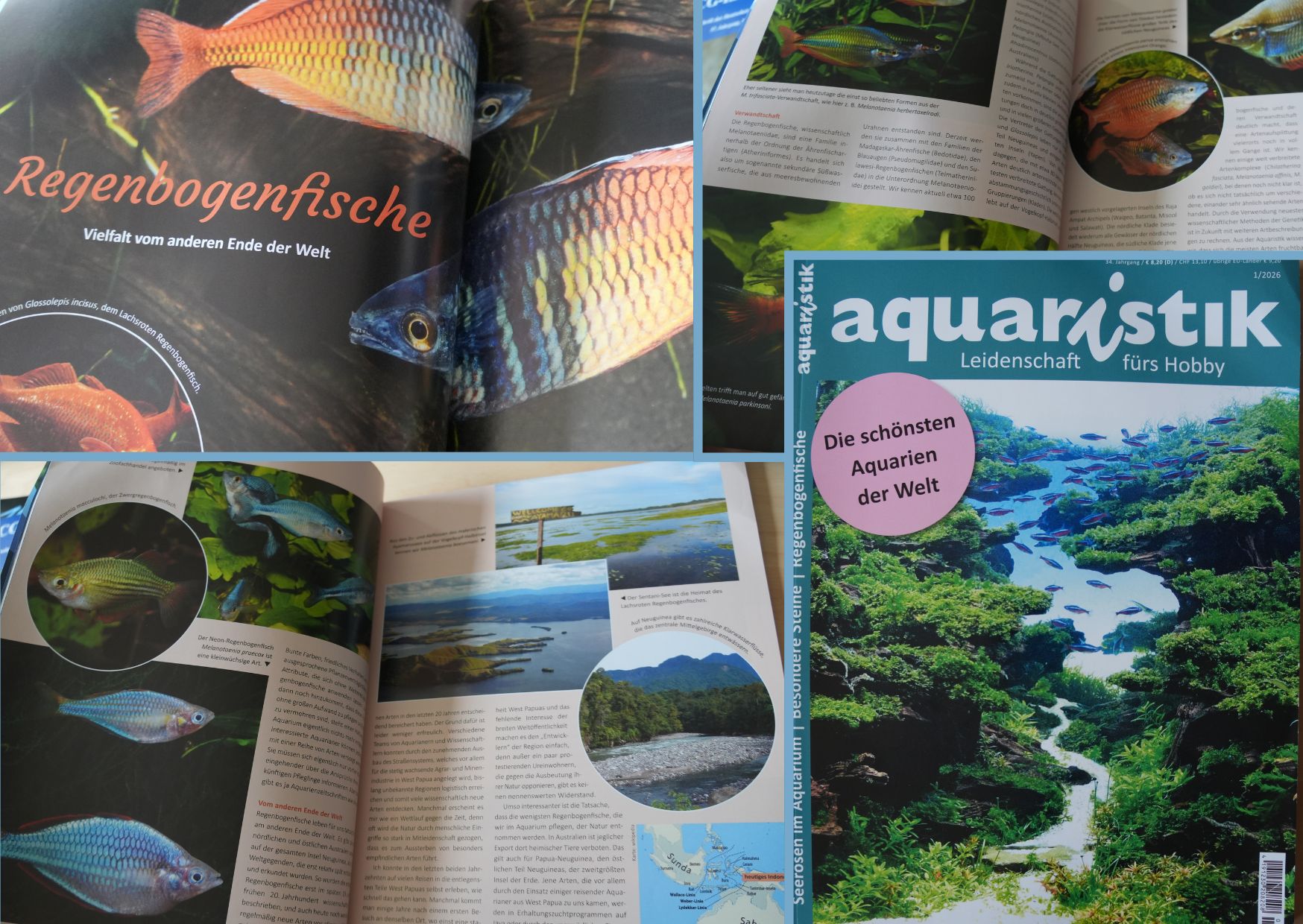
The Journey to New Rainbowfish of Papua New Guinea in Aquaristik 1/2026
The article by Hans-Georg Evers takes us to the remote areas of Western Papua (around the Taritatu River and Lake Bira), where the author and his team searched for new and rare forms of rainbowfish (Melanotaeniidae).
Chilatherina sp. "Taritatu" is likely a new species discovered in the tributaries of the Taritatu River (the so-called Kali Biru – "Blue River"). The fish is characterized by fascinating coloring - the front two-thirds of the body are bright blue to white, while the back third is intensely red, especially in dominant males during courtship.
Chilatherina bleheri: The article documents a visit to Lake Bira (also known as Lake Holmes), which is home to this iconic species. Hans-Georg Evers describes the change in appearance of the fish depending on age – older males acquire a high back and specific pattern.
Melanotaenia goldiei: Observed in clear, flowing waters near the town of Timika in the southern part of Western Papua.
If you are considering breeding them
If you plan to breed rainbowfish, it is essential to realize that they require clean, oxygenated water with a gentle current. Regular water changes (about 30% weekly) are ideal, stimulating the fish to be active and spawn. Most species thrive in moderately hard water with neutral to slightly alkaline pH. Regarding food, the author emphasizes variety. Although quality pellets are sufficient, live and frozen food (daphnia, mosquito larvae) are key to vibrant colors. He warns against nematodes and brine shrimp from poor sources, which can cause intestinal issues.
Fish lay eggs in fine-leaved plants or artificial spawning mops. The key problem is not the spawning itself but feeding the microscopic fry in the first days (infusoria or brine shrimp nauplii are suitable; later, artemia nauplii). Fry lose their yolk sac after hatching and must be fed immediately. If live plankton (infusoria, daphnia) is not available, it is recommended as an emergency solution to use hard-boiled egg yolk pressed through a fine sieve (watch out for rapid water spoilage).
The article confirms that rainbowfish can be successfully bred with other mild species, for example, with "Blue eye" Pseudomugil ivantsoffi. Hanse-Georg Evers emphasizes the importance of maintaining clean lines in aquariums to prevent the crossing of different species and forms. Even after 30 years since the first imports, Papua New Guinea remains an inexhaustible treasure trove of aquaristics, as evidenced by the current discovery of the "Taritatu" form, whose DNA is now being studied by scientists in Australia.
News from Science and Taxonomy (Aquaristik 1/2026)
Revision of the genus Devario in Sri Lanka
A new study (Sudasinghe et al., 2025) has brought significant clarity to the distribution and kinship relationships of the genus Devario on this island. The originally mentioned seven forms have been reduced to five valid species. Two previously described species have been designated as synonyms.
New species Devario altus: Scientists described a fifth species that is highly specialized and occurs only at one locality at an altitude of 1580 m above sea level.
The study on 136 samples revealed that in nature, frequent hybridization occurs between species (Devario malabaricus x Devario pathirana and Devario malabaricus x Devario micronema). The generalist Devario malabaricus due to its adaptability comes into contact with all other specialized species.
The new "Royal Tetra" Inpaichthys luizae
Previously known under the trade name "Black Arrow," this tetra from central Brazil (Rio Tapajós basin) has now been officially scientifically described. A typical feature is a wide black longitudinal stripe running from the pectoral fins to the middle of the caudal fin. The species exhibits a peculiarity in the presence of a fatty fin. Some individuals have it, while others lack it, which is unusual for a single species.
Although it has only now been scientifically described, due to rapid commercial breeding, it is already widely available on the aquaristic market, which reduces pressure on wild populations.
DCG Information
January 2026 (57th year)
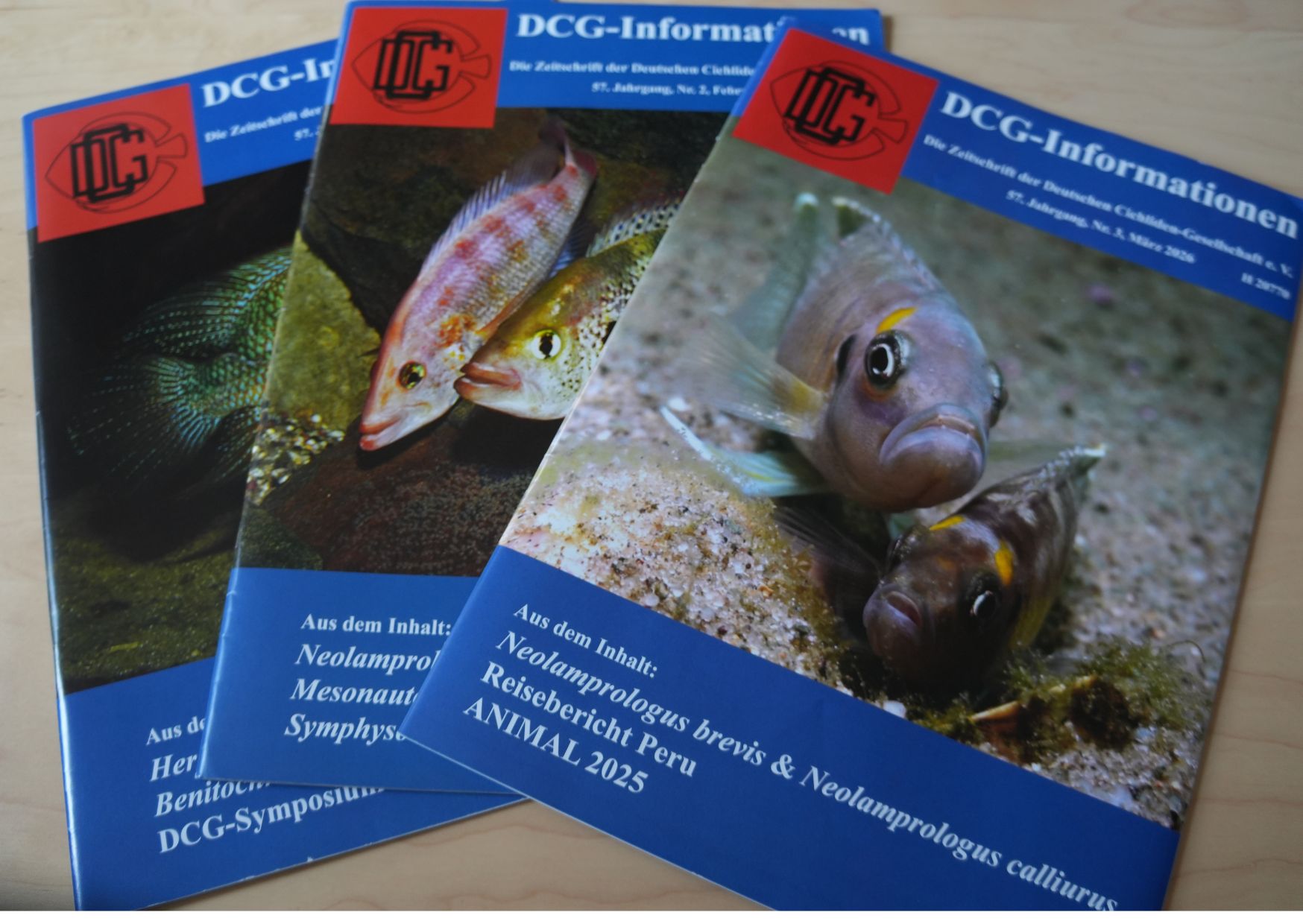
We cannot overlook the article about the DCG symposium in Münster, authored by Linda Vlachová from ForAquarist. It was a very successful event held at the local zoo, where participants could listen to interesting lectures by Dieter Untergasser, Dr. Stefan Pierdziga, Dr. Stanislav Kislyuk, or Dr. András Spreinat. More about this journey and the symposium itself is brought by the report DCG Symposium: 800 km for Inspiration - from Kutná Hora to the DCG Congress in Münster Zoo
📚 Cichlids: Surprising Breeding and Taxonomy
Another noteworthy text is an article by Uwe Werner dedicated to the species Bentochromis nigrodorsalis.(4)
Benitochromis nigrodorsalis is among the most interesting yet still underrated West African cichlids. This West African cichlid from small streams below Mount Cameroon is one of the extraordinarily interesting species. It captivates not only with its pattern and pronounced sexual dimorphism but also with its unusual reproductive behavior. In Benitochromis nigrodorsalis, the initiative during courtship is taken by the female . She actively attracts a partner in full coloration, while the male reacts only to her prompts, which is unusual for cichlids and makes this inconspicuous species from Cameroonian streams extraordinarily attractive for observation.
February 2026 (57th year)
A very interesting article from the February issue is Inga Schindler's on the latest developments in the taxonomy of the genus Mesonauta. For aquarists, this topic is attractive precisely because these cichlids are among the well-known and popular South American fish, yet their systematics remains unfinished.
The main focus is on the newly described species Mesonauta karipuna from the Brazilian state of Amapá. The author clearly shows the characteristics by which this species can be distinguished from related forms, especially based on the pattern of dark stripes on the body. The combination of pattern, morphological features, and new molecular data gives the article great value even for experienced readers.
The text also serves as a good reminder that taxonomy is not a dead discipline but a living process. What has long been taken as established in aquariums may be understood differently after new revisions. For those interested in South American cichlids, this is one of those articles worth careful reading. (5)
Wolfgang Staeck in his article about discus from the vicinity of Iquitos shows Symphysodon not only as iconic aquarium fish but also as species closely tied to the rhythm of Amazonian floods, local occurrence, and the reality of capture for export. The text connects biology, geography, and aquaristic practice, making it quite interesting.
March 2026 (57th year)
In the March issue, a very interesting text is dedicated to the Tanganyikan shell-dwellers Neolamprologus brevis and Neolamprologus calliurus. At first glance, they are closely related and easily confused fish, but the article shows that the differences between them are not just a matter of name, but also of their actual way of life. In addition to taxonomic connections, the author also discusses fundamentally different pairing strategies: while Neolamprologus brevis forms stable pairs, a polygamous model is observed in Neolamprologus calliurus. The combination of systematics, field observations, and reproductive biology makes the article extraordinarily stimulating reading for anyone interested in cichlids from Lake Tanganyika.
📖 List of Used Literature (Q1/2026)
Magazine Amazonas (March/April 2026)
- (1) BITTER, Friedrich. Development of the Japanese Ricefish. Amazonas. 2026, vol. 22, no. 2 (March/April), pp. 10–17.
- (1) BITTER, Friedrich. Ricefish Breeding Forms. Amazonas. 2026, vol. 22, no. 2 (March/April), pp. 18–27.
- (2) EVERS, Hans-Georg. On the Knowledge of Two New Ricefish from Sulawesi. Amazonas. 2026, vol. 22, no. 2 (March/April), pp. 28–35.
- (3) SUTTER, Rudolf. Beautiful and Useful: The Tiger Lotus. Amazonas. 2026, vol. 22, no. 2 (March/April).
Magazine Aquaristik (3/2026)
- (8) KALUZA, Markus. Fascination Pseudacanthicus & Leporacanthicus: Vampires in the Aquarium. Aquaristik. 2026, no. 3, pp. 16–27.
- (8) KALUZA, Markus. Fascination Pseudacanthicus & Leporacanthicus: Giants Among the Armored Catfish. Aquaristik. 2026, no. 3, pp. 28–31.
- (9) UNTERGASSER, Dieter. The Feed Makes the Difference: Consequences of Incorrect Nutrition in Fish. Aquaristik. 2026, no. 3, pp. 18–22.
- (10) KAMMERER, Martin. Koi Pond with Concept: Through Good Planning and Foresight to Success. Aquaristik. 2026, no. 3, pp. 40–45.
Magazine Aquaristik (1/2026)
- (11) EVERS, Hans-Georg. A New Rainbow in the Sky: Chilatherina sp. "Taritatu". Aquaristik. 2026, 34(1), 24–32. ISSN 1431-5564.
- (12) SUDASINGHE, H., et al. From 7 to 5: Devario Barbs. Aquaristik. 2026, 34(1), 10. ISSN 1431-5564.
- (13) DAGOSTA, F. C. P. An Ode to Beauty: The Discovery of One of the Most Spectacular Tetras (Characiformes: Acestrorhaphidae) – A New Species of Inpaichthys from the Rio Juruena, Brazil. Neotropical Ichthyology [online]. 2025, 23(3) [cited 2026-04-01]. Available from: https://doi.org/10.1590/1982-0224-2025-0052. (Referenced in Aquaristik 1/2026, p. 11).
Magazine DCG Information (January–March 2026)
- VLACHOVÁ, Linda. DCG Symposium: 800 km for Inspiration – from Kutná Hora to the DCG Congress in Münster Zoo. DCG Information. 2026, vol. 57, no. 1 (January).
- (4) WERNER, Uwe. Home in Cameroon: Benitochromis nigrodorsalis (Lamboj, 2001). DCG Information. 2026, vol. 57, no. 1 (January).
- (5) SCHINDLER, Ingo. New Developments in the Taxonomy of the Flag Cichlids (Mesonauta). DCG Information. 2026, vol. 57, no. 2 (February).
- (6) STAECK, Wolfgang. Discus Cichlids from the Vicinity of Iquitos. DCG Information. 2026, vol. 57, no. 2 (February).
- (7) BÜSCHER, Heinz H. Comparison of Reproductive Strategies: Neolamprologus brevis and Neolamprologus calliurus. DCG Information. 2026, vol. 57, no. 3 (March).