


The genus Apistogramma has fascinated aquarists for decades with its vibrant colors and complex social behavior. However, while the number of species in our aquariums is steadily increasing, the sensitive digestion and specific water parameters of their South American homeland present many keepers with challenges. This article highlights the entire journey from the critical eye when purchasing fish through the gentle acclimatization using the drip method to the design of authentic biotopes. Learn why these "cave breeders" are much more than just an aesthetic enhancement for the community tank and how you can provide even demanding species with a species-appropriate home.
Dwarf cichlids of the genus Apistogramma
Dwarf cichlids of the genus Apistogramma have been very popular among aquarists in Germany for many years. Many aquarists take their first steps in breeding with them. The species bring some variety to the community tank with their behavior. The number of species has exploded in recent decades. The knowledge of aquarists about these dwarf cichlids has also increased significantly.
In 1977, the first Apistogramma working group was introduced in the USA by Mark McMaster. They designated the unknown species with the addition "Apistogramma Study Group" (ASG) and a number.
The pet trade has adapted its offerings to this interest in the genus and regularly offers a certain spectrum of species. Therefore, I would like to present some of these species in this article and address their partly quite different requirements and needs. Unfortunately, I do not know what role the genus plays in the aquariums of our Czech friends. But I am sure: there is certainly interest.
Shopping spree: Eyes open when buying fish
For every aquarist, the walk through the pet store from tank to tank is an exciting moment. After a seemingly endless row of tanks with breeding forms of guppies and platies finally reaches the aquariums with the dwarf cichlids, it may itch in the fingers right away. One or another magnificent species is the one you would like to buy immediately.
But before the perhaps spontaneous purchase, there are a few things to consider.
- Does the species even fit the inhabitants of my aquarium?
- Would bullies make their lives difficult or would the territories not suffice for further purchases?
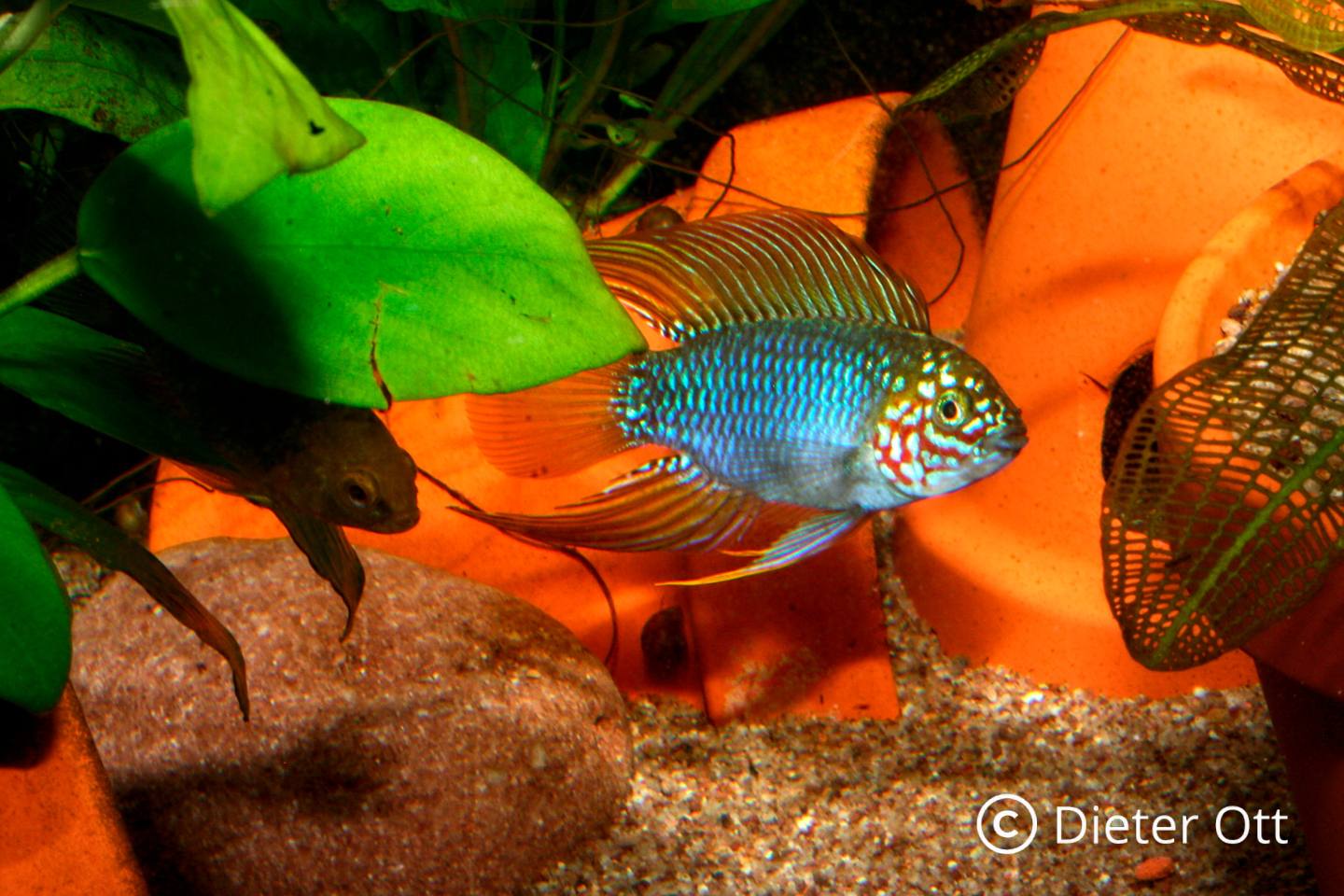
In the case of Apistogramma species, it is also very important to check whether both sexes are actually present among the offered animals when thinking about offspring. Of course, there is often at least one magnificent male among the fish in the sales tank. It should first be considered that "magnificent" is often synonymous with "old." In this case, this means checking their intentions.
If a suitable aquarium for breeding is available, an older animal can also be used for breeding. Otherwise, it would be better to choose a less well-developed younger male.
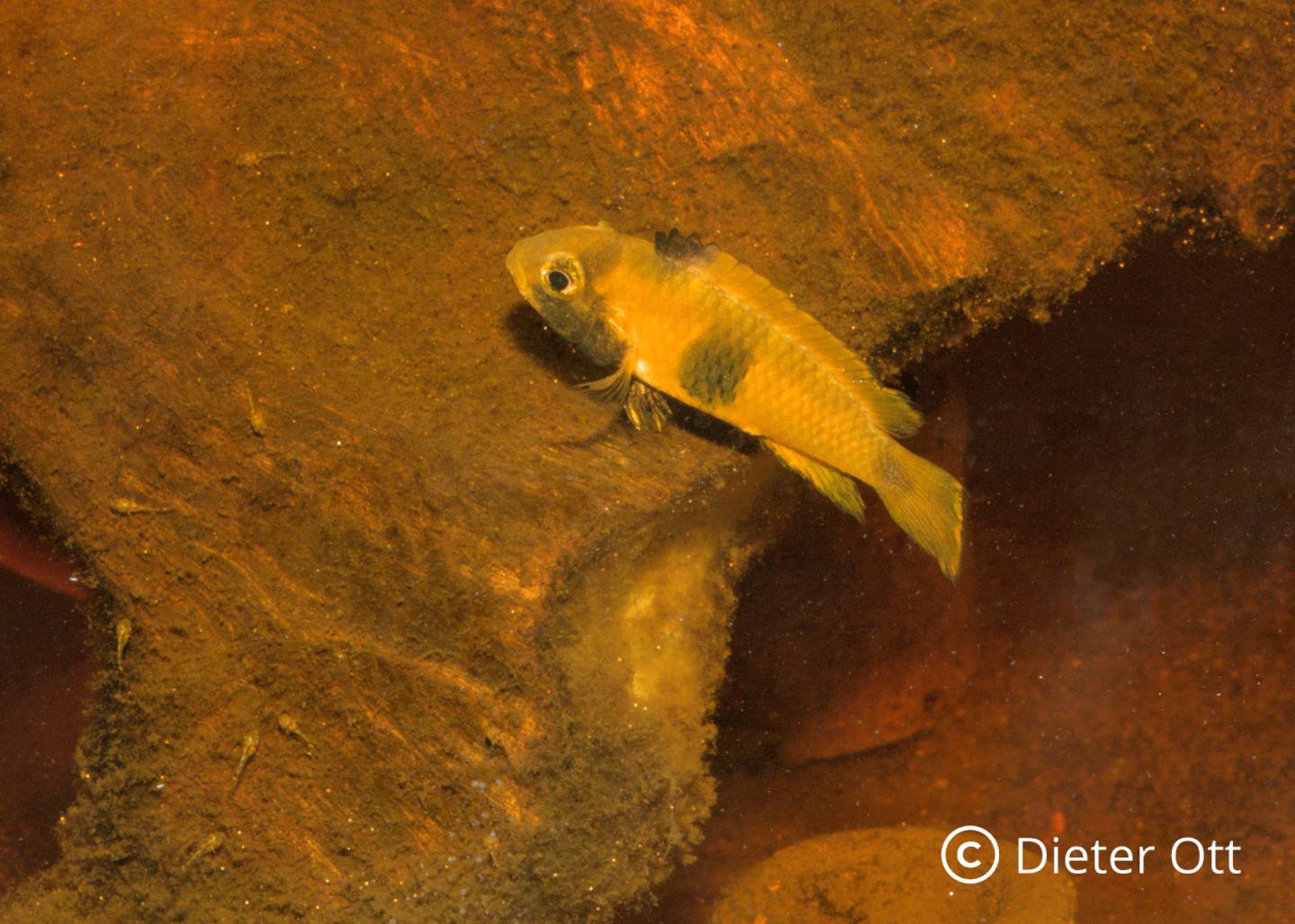
But then comes the far more difficult selection of a female. Unfortunately, we sometimes encounter sales tanks where only males are swimming, one beautifully developed and then some that resemble females because they are camouflaging themselves from the aggression of this male. Here, it helps to look closely and have certain fish caught out. The females of some species can be recognized by a black marking in the front area of the pectoral fin. Unfortunately, this only applies to a part of the species, so the selection must be made with care.
Of course, we want to buy healthy fish, and the pet stores are also striving to keep their offered pets healthy. However, the digestive tract of the Apistogramma is very sensitive. By nature, they are small animal eaters.
Not a few species are conditioned over time to accept dry food. This poses a significant burden on the digestive tract. But also with other food, the Apistogramma can suddenly have problems and show this with a whitish fecal thread. A purchase is then not advisable, as it is of course for all other signs of disease, such as clamped fins, cloudiness, etc.
The water hardness and temperature of one's own tank should match the desired new acquisitions.
Welcome home: The acclimatization
To allow the new acquisitions to be placed in one's own aquarium without complications, it is helpful to ask the sellerabout the water values in the sales tank. Otherwise, I would suggest measuring the values myself. At home, I always place the fish in a small tank and let water from the care tank drip into this small aquarium with a thin hose. The chosen speed depends on the deviations of the water parameters in the pet store. I set it precisely with a small Gardena valve.
In the process, I observe the fish from time to time. When they breathe relatively calmly, I then promptly place them in the large aquarium.
Setup and biotopes
The required tank size depends on the species and number. I usually keep my species in species tanks of just under 60 liters.
I regularly observe the fish. If the animals damage their fins too much or some animals do not get to the food, I intervene and separate them.
From the outset, it is important to offer several covers. The smaller body size means that the Apistogramma are threatened by predators in their natural habitat. Therefore, they seek out biotopes that offer sufficient hiding places and retreat opportunities. The species have thus retreated from the large rivers to small streams and ponds. Here they live in shallower water and – as far as available – in dense plant growth, as we encountered in Paraguay when catching Apistogramma borellii .
Cover is also provided by the base areas of plants growing above the water or grasses reaching into the water. These small fish often stay in leaf litter accumulations and between roots, which naturally also acidify the water. To Apistogramma nijsseniI have described such a biotope in more detail.
Reproduction: Hiding instead of cave breeding
In aquaristics, it has become customary to offer these fish caves as cover and retreat areas, even though they also utilize plant growth or, for example, roots in the same way. Because all Apistogrammaspecies usually lay their eggs in places beneath a hiding spot, where the females turn on their backs to spawn, these supports are also used for reproduction. Therefore, these animals are sometimes referred to as cave breeders, although "hiding breeders" describes their behavior much more accurately.
With considerable effort, Lorenzen (1998) studied the subsequent reaction of young Apistogramma borellii with regard to the "innate releasing mechanism" (IRM). The temporal delimitation of the period around the 6th free-swimming day, when the initial juvenile-juvenile bond shifts in favor of a maternal bond, has never been noticeable to me in practice. And that the willingness to act in this maternal bond is only present until around the 43rd day of free swimming, when it was first triggered in a "sensitive phase" (18th free-swimming day), provides clues for aquarium observations and comparisons with other species (Ott, 2023).
Water parameters: The "Amazon formula"
A large number of the Apistogrammaspecies swimming in our aquariums are found in Amazonia. The definition of this area varies somewhat depending on the author. Essentially, this area can be described as the basin of the Amazon River. Here, due to the abundant rainfall, water is predominantly found that resembles distilled water.
- The pH value is always in the acidic range and can thus reach extreme values from the aquarist's perspective.
- The average temperature of the water in the lakes studied in Amazonia is 28.6°C.
However, there are scattered areas that can exhibit significantly different values in every respect. From the eastern slopes of the Andes flow waters that can carry significantly harder water with an alkaline pH value. Moreover, there are also areas where the water parameters are quite different. It is therefore worth it for the keeper of Apistogramma species to inform themselves more closely in each individual case.
Tips for keeping at home
In general, it is true that the species can usually be kept without problems in harder water despite these extreme water values in their natural habitats. I have little trouble in this regard, as my tap water with 5.5 dGH can be used for many species. I just have to bring it into the acidic range with hydrochloric acid from an alkaline pH of around 8. Various authors mention boundary values of 6 to 10 dGH.
For breeding, we definitely need soft water and then the question arises as to how we can achieve this. As so often, there are many ways to Rome. Reliable water can be produced with ion exchangers or reverse osmosis systems. In some areas of Germany, rainwater can also be used.
As I have personally experienced, peat only helps temporarily. It is possible, for example, to reduce hardness and pH value within limits through peat filtration. But after not too long, the effect of the peat diminishes, and the peat must be renewed to maintain the effect; otherwise, it reverses.
Often, aerators and various filters are recommended to cleanse the water and increase the oxygen content. In my opinion, it depends greatly on the stocking. With a higher stocking density, these aids are of course necessary. In my species tanks, which have a low fish count, I manage without technology.
Due to their largely calm behavior, Apistogramma can be kept well with peaceful fish species such as tetras, catfish, or plecos. The species reach an age of about two to three years, which is why I generally consider the purchase of younger animals to be sensible.
The next issue will be published on Wednesday, March 25, 2026. Among other things, we will focus on popular species of the genus Apistogramma.
Literature:
- Amlacher, E. (1958): Ornamental fish diseases. 3rd continuation. II. Special part (the individual fish diseases). – AT 5(10): October: 292–296.
- Bone, Q. & Marshall, N. B. (1985): Biology of fish. Fischer, Stuttgart, New York. 236 pages.
- Bremer, H. (1993): Water and food. Two essential pillars of cichlid care. – Cichlid Yearbook: 86–95.
- Bremer, H. (1997): Feeding aquarium fish healthily. – Verlag Eugen Ulmer GmbH & Co., Stuttgart. 191 pages.
- Fiedler, K. (1991): Fishes. In: Starck, D. (Ed.): Textbook of Special Zoology. Volume II: Vertebrates. Part 2: Fishes. Gustav Fischer Verlag, Jena. 498 pages.
- Hättich, F. & Römer, U. (2018): Apistogramma sp. "Diamond Band" – A newly discovered dwarf cichlid from the basin of the Rio Vaupés. – DCG-Informationen 49 (2): 32–41.
- Kullander, S. O. (1989): Biotoecus Eigenmann and Kennedy (Teleostei: Cichlidae): description of a new species from the Orinoco Basin and revised generic diagnosis. – Journal of Natural History, 23: 225–260 (not seen).
- Linke, H. & Staeck, W. (1984): American cichlids I. Small cichlids. – Tetra Verlag, Melle. 194 pages.
- Lüling, K. H. (1977): The bone-eating fish. – A. Ziemsen Verlag. 104 pages.
- McMaster, M. (1977): On the hobby species of Apistogramma. – Cichlid Bulletin (60): 3–10.
- Ott, D. (1966): Apistogramma taeniatum. – DATZ 19(2): 7–9.
- Ott, D. (2023): All about the so-called yellow dwarf cichlid, Apistogramma borellii (Regan, 1906). – DCG-I 54(2): 30–35.
- Römer, U. (1998): Cichlid Atlas: Natural history of the dwarf cichlids of South America. Volume 1. – Mergus Verlag GmbH, Melle. 1311 pages.
- Staeck, W. (2003): South American dwarf cichlids. Cichlid Lexicon, Part 3. – Dähne Verlag GmbH, Ettlingen. 219 pages.
- Ziemek, H.-P. (2011): Interstitial fauna and flora. Sand and gravel ... delicious! – DATZ 64(8): 31–33.