

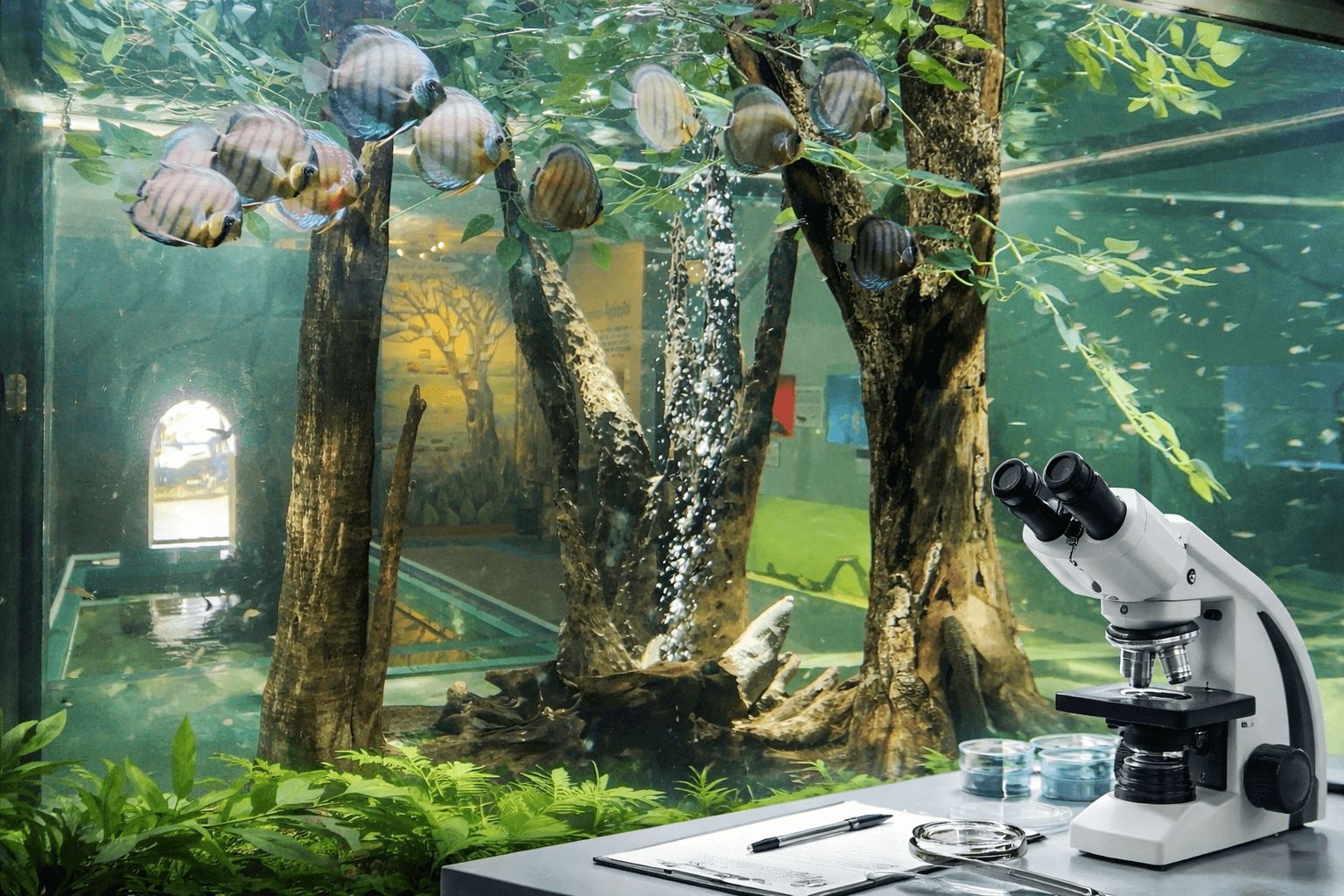


ARCOF in Iquitos, Peru, demonstrates that aquaristics can have a real impact. The unique project combines research, assistance to local communities, and the protection of the future of ornamental fish.
Imagine that you have been dedicated to aquaristics for a longer time and you are really successful in breeding fish. As a next step, you want to acquire ornamental fish with a clear origin – ideally directly from the area of Iquitos in Peru. However, at that very moment, a fundamental question arises: will you find a truly reliable local breeder that you can trust, or will you have to look across the ocean?
And then you pause for a moment. It's not just about the price. The ethical aspect of the matter also comes to the forefront. Are you inadvertently supporting something that you do not internally identify with?
You start to become interested in what the situation looks like in the place of origin of the fish. Are the populations in their native rivers still numerous? Is the catch being conducted sustainably? And what are the conditions in the very center of the ornamental fish trade in the Peruvian Amazon?
Whether you are asking yourself similar questions or you are just interested in the current events in Iquitos – a significant center and hub for ornamental fish – the interview that ForAquarist conducted with the leadership of the unique project ARCOF (Amazon Research Center for Ornamental Fishes) is definitely worth your attention.
How the ARCOF project was created
The story of the center began to be written at the moment when Carlos Chuquipionda, a former manager of the largest fish exporter in Peru, had the bold idea: to establish his own research center focused on ornamental fish. With this vision, he approached Dr. Anthony Mazerolla, a retired biology professor.
The initial reaction was understandably cautious. However, when Anthony Mazeroll and his wife thoroughly considered the whole idea, they concluded that it was not an unrealistic dream, but a project with a deeper meaning. They therefore decided to purchase a piece of land on which the center could be built. After years of preparation and planning, they finally began the actual construction in 2018.
Sustainability and helping locals
One of the main goals of ARCOF is to support sustainability in the region. If local fishermen adopt more sustainable catching techniques and better understand the subsequent care of the fish, the mortality rate of fish during transport to the United States and Europe can be significantly reduced.
The next step is to teach local residents to breed fish purposefully. At first glance, this may seem paradoxical: why should they breed fish when they literally have them in their backyard?
The answer is provided by the local nature itself. During the rainy season, river levels rise in some areas by tens of meters, and the landscape changes dramatically. Let’s recall the well-known phenomenon igapó – seasonally flooded forests that become a space of abundance and reproduction for fish during this time. However, at that time, the catch of ornamental fish is practically out of the question.
Local residents often seek other sources of income – and these can take the form of illegal logging or reckless hunting of freely living animals. This raises a fundamental question: wouldn’t it be better if they could stay home, breed fish themselves, and secure a more stable livelihood without destroying the surrounding rainforest?
This is precisely where one of the greatest contributions of the ARCOF project lies.
Education and awareness
Over time, it became clear that the research alone would not be enough. If the project is to have a long-term impact, it is necessary to work with the local community as well – especially with children. This is why the idea arose to build a public aquarium that would assist with education and awareness.
It may sound surprising, but many local residents have never actually seen most ornamental fish. This is a paradox of an area that belongs to the most biologically valuable places on the planet. However, this ignorance prevents a deeper understanding of the value of the surrounding environment.
From an aquarist's perspective, these are truly natural treasures that local people have almost at their fingertips. It is all the more important for them to realize how exceptional the region they live in is – and what fundamental role they will play in deciding its future.
The path to realization was not easy
Building such a center in the Peruvian Amazon was by no means easy. It is all the more admirable that today ARCOF truly exists.
After the first tanks were installed, some of them began to leak after a few months. The main cause was the local fresh wood, which was not sufficiently dried. As it gradually dried out, the joints loosened, and the large tanks stopped sealing.
Another problem was the epoxy coating. It had proven itself in the United States, but in Peru, its quality turned out to be different. Underwater, it soon began to form bubbles and had to be replaced with another solution.
And the troubles did not end there. The trader responsible for importing the ordered acrylic aquariums from China did not adhere to the agreed conditions, and it was necessary to pay additional storage fees amounting to approximately 10,000 euros.
A bridge between aquaristics, science, and helping the region
Despite all the obstacles, today the ARCOF center stands and represents an extraordinary project that connects commercial aquaristics, scientific research, and concrete social assistance in the region of the Peruvian Amazon, especially around the city of Iquitos.
It’s not just about fish. It’s about the landscape, the people, education, and the future of a place that belongs to the most remarkable freshwater areas in the world.
The interview with the founders of the project, Dr. Anthony Mazeroll and Renee Mazeroll, offers a unique insight into the behind-the-scenes of the entire initiative and the problems that today’s Peruvian aquaristic reality faces.
Here you can watch the entire interview:
ARCOF is the first research center in the world dedicated exclusively to ornamental fish.