


Every experienced aquarist knows that the path to a thriving tank does not lead through shiny catalogs, but through years of trials, errors, and practical improvements. This time, we focused our discussion with long-time breeders Láďa and Luděk on the construction of aquarium stands, water treatment, and the influence of mineral ratios on fish development.
Stable base and quiet operation
Construction: Iron above the wood structure
Many aquarists encounter the limits of commercial aquarium stands sooner or later. While they may look attractive in a living room, they can warp under the weight of hundreds of liters of water and the influence of humidity. Therefore, Láďa relies on an iron skeleton.
-
Metalworking: The foundation is a welded construction with adjustable legs. This is absolutely crucial in houses with uneven floors, where even a millimeter of tilt can cause structural stress in the glass of a large aquarium.
-
Aesthetics without Compromise: To ensure the technical appearance does not disrupt the interior, the stand is laminated. The use of ABS edges is essential—it protects the material from swelling when in contact with water, which is inevitable during long-term maintenance.
Filtration: Betting on quiet performance
When it comes to filtration, Luděk shared a clear recommendation:
Nobody has come up with anything better than Eheim. The quality of a filter is not just determined by the flow rate, but primarily by the mechanical precision of the pump.
Thanks to precise processing, the noise of the equipment is minimal even without additional soundproofing of the cabinet. This is essential for aquariums located in bedrooms or living rooms. A quality pump simply does not resonate and maintains its performance for many years.
Water treatment: Sometimes just "tap water" is not enough
The water in Turnov and the surrounding area is often hard, which poses a problem for keeping more demanding species. The solution is Reverse Osmosis (RO).
- Efficiency and Handling: Standard osmosis systems produce large amounts of waste water. However, by using two membranes, a 1:1 ratio can be achieved (obtaining 500 liters of pure water from 1000 liters of input).
- Practical Tip: Forget about hauling buckets. Simply connect the osmosis system in the bathroom directly to a shower hose and use a pump (again, the proven Eheim) to transfer the RO water into storage tanks under the aquarium.
- Maintenance: Sediment and carbon filters need replacement after about 6,000 liters, while membranes can last up to 40,000 liters. A clear signal for replacement is an increase in conductivity (e.g., from a standard 18 μS to 100 μS).
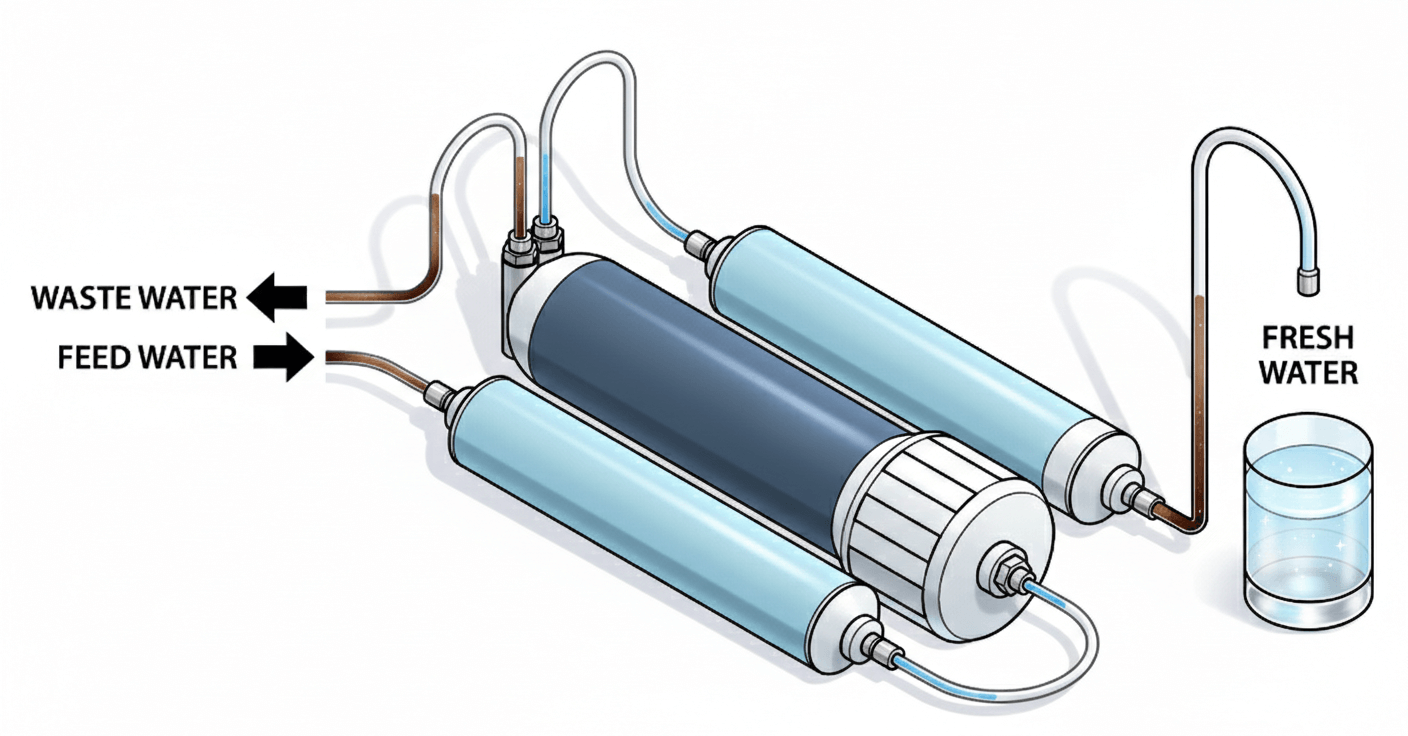
Reverse Osmosis System Diagram
Alchemy with minerals: Calcium vs. magnesium
An interesting observation from practice (backed by experiments from aquarist expert Ivo Barteček) is the influence of the mineral ratios on fish. Specifically, for this experiment, the cichlids Microgeophagus ramirezi were chosen.
While in our water supply, calcium predominates over magnesium in a ratio of 2:1, in natural habitats, this is often reversed. Experiments showed that a ratio of 1 part calcium to 2 parts magnesium has a fundamental impact on:
-
The structure and shape of the fish's body.
-
The speed of sexual maturation.
CO2 and pH: Less is sometimes more
To adjust pH, CO2 with a reactor can be used, but it also holds true that overly precise measurements can be problematic. After experiences with constant calibration of probes, Lála returns to the proven "bubble estimate" and observing the fish. This is possible due to the large volume of the aquarium, which provides high stability. It is sufficient to monitor the pressure in the bottle to prevent an "end-of-tank dump" (uncontrolled gas release) when the bottle is nearly empty.
The myth of changing filter media
As a final piece of advice regarding filtration:
Do not believe retailers who claim you must change your filter media every three months.
A quality bio-sponge, such as a 10 cm thick sheet in a Hamburg Mattenfilter (HMF)*, can last for years. Over time, it may "harden" due to bacterial biofilm and waste, but instead of discarding it, the best remedy is a thorough rinse. This restores its original permeability and flexibility.
* What is a Hamburg Mattenfilter (HMF)?
The HMF is essentially a large sheet of bio-sponge that functions as a "living wall." Instead of a complex machine, it relies on a massive surface area and biological activity.
- Biological force: Thanks to the slow flow rate, the bacteria in the sponge have enough time to clean the water. This is much more efficient than fast water chasing in a small filter.
- Low maintenance: This filter does not need to be cleaned for months, sometimes even years. The older it gets, the better it works.
- Nursery for fry: The water flow is so gentle that it does not endanger even freshly hatched fry or shrimp. They also like to feed on it as microorganisms cling to the surface.
Hamburger Mattenfilter - source "Aquaristik ohne Geheimnisse" - (Aquaristics without secrets)
1. What is a Biofilter (Bioreactor)?
Traditional filters often focus on mechanical cleaning (removal of sludge). However, HMF (Hamburger Mattenfilter) primarily functions as a bioreactor.
- Bacteria are the filter: The actual filter is not ceramic rings or sponge, but a community of bacteria that inhabit surfaces.
- Catalyst: The filter merely accelerates natural processes of decomposition of organic substances.
- Stability: HMF provides bacteria with "protected areas," thereby increasing the biological capacity of the aquarium (creating the effect of "greater volume" of water in terms of breaking down harmful substances).
2. Biological processes in the filter
Nitrification: An aerobic process (requiring oxygen) in which bacteria convert ammonia/ammonium into nitrites and subsequently into relatively harmless nitrates.
Oxygen consumption: As water passes through the filter, the O2 level drops by about 0.5 mg/l, which is safe at normal levels (5 mg/l+).
By-products: Besides nitrates, CO2 is produced, which benefits plants.
Denitrification: In certain zones with low oxygen content, there may be a reduction of nitrates, which helps maintain stable pH and alkalinity.
3. Technical parameters and calculations
The key to HMF success is the correct flow rate of water through the medium.
Main principles:
Flow rate: The contents of the aquarium should ideally pass through the filter 1 to 2 times per hour.
Flow speed (V): The optimal range is 5 to 10 cm/min. At too high speeds, bacteria cannot adhere to the substrate. At too low speeds, there may be insufficient aeration.
Surface area of bio-sponge: Generally, the entire side wall of the aquarium is utilized.
Calculation formulas: Pump flow rate (L/h): n * Q (n = number of volume turnovers, Q = volume of the aquarium).
Surface area of bio-sponge (A): A = (Q * n * 1000)/(V * 60) (result in cm2).
4. Construction and maintenance
Construction: The sponge plate (thickness 3–5 cm) is placed about 2 cm from the wall of the aquarium, creating a chamber for the pump, heater, and probes.
Pump: Water is drawn from the space behind the mattress and returned to the aquarium. A motor pump or air lift "pump" can be used.
Start-up: Takes several weeks. The blue color of the sponge will turn brown over time, indicating colonization by bacteria.
Maintenance: Nearly zero. The mattress is not washed until there is a noticeable significant difference in water levels before and after the filter (which can take years). The sludge behind the filter is biologically active and should not be removed.
5. Summary of advantages and limitations
Advantages: Extremely low costs, high biological safety, long lifespan, hiding place for fry, space for equipment.
Disadvantages: Takes up space inside the aquarium, aesthetically unpleasing for some (can be solved by planting moss).
Limitations: Unsuitable for marine aquariums and extremely overstocked tanks without plants, where mechanical cleaning predominates over biological.