




The Bible of aquarium diagnostics is back in a new guise. Dieter Untergasser has published, after years of waiting, the updated work Krankheiten der Zierfische (2024), which pushes the boundaries of aquaculture. From autopsy findings to modern diagnostics using QR codes and videos – this book offers answers where online advice fails. Read the review of the publication that even the esteemed ichthyologist Anton Lamboje has labeled as the new standard in aquaristics.
Diseases of Ornamental Fish (Krankheiten der Zierfische) - Dieter Untergasser
Already in my childhood, I was intrigued when I read in the book 222x How and Why that fish are among the animals with the greatest diversity of diseases. With the passage of years, I can only confirm this fact. Our scaly pets are exposed to large numbers of various dangers, and we as their keepers are here to protect them. We have a responsibility for them.
I realize how amazing these creatures are, and I generally dislike acquiring new specimens – the main reason being, of course, diseases. Quarantine cannot be underestimated, as some diseases may manifest only after a long time, sometimes even after six months, and sometimes their triggers may wait much longer.
The previous edition of the book Diseases of Ornamental Fish by Dieter Untergasser was sold out, so original prints today reach several times the original price. The new, expanded, and revised version from 2024 is still available. The language barrier for those who do not speak German may be an obstacle, but today you can quite comfortably translate pages with a mobile phone or tablet in hand.
Diagnosis and Treatment of Diseases
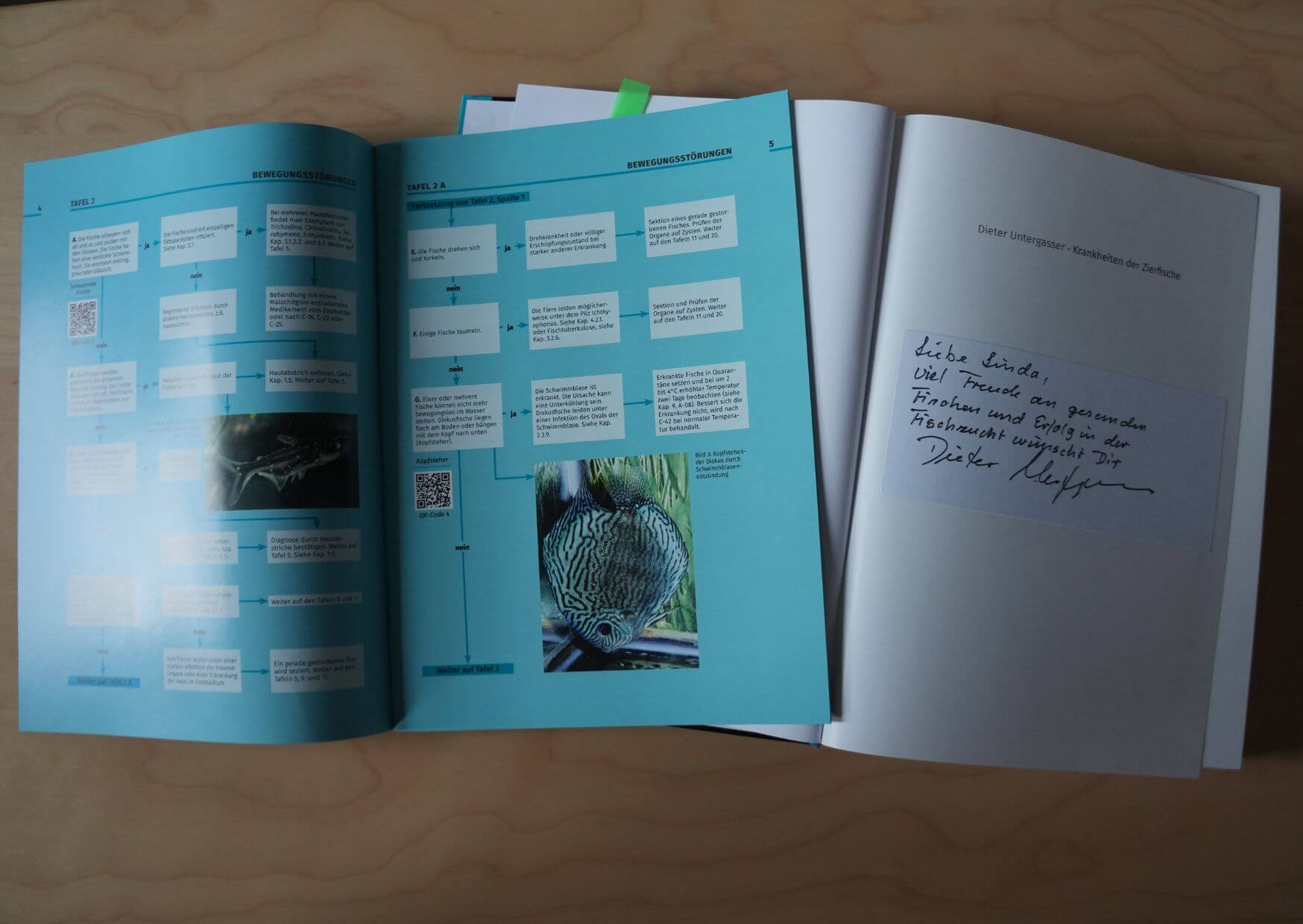
The book Diseases of Ornamental Fish is designed to fulfill its main purpose: prevention, diagnosis, and treatment of diseases. It also includes a practical checklist that logically guides the reader through the diagnosis of diseases.
Dieter Untergasser has equipped the book with numerous photographs and QR codes that lead the reader to videos documenting the symptoms of diseases. The videos are illustrative and understandable even without language knowledge.
Chapter 9 “Treatment of Sick Fish” provides an exhaustive overview of four main categories of treatment:
- Antibiotics
- Biological and Preventive Methods of Protection
- Chemotherapy
- Disinfection Measures
Once you identify the disease based on the described symptoms (and with the help of the accompanying checklist), you can read what the correct dosage is and for how long. For each treatment substance, it is indicated whether it is prescription-only or generally available. You may sometimes find that treatment is not so complicated, but then there will be situations where you start looking for a doctor who would prescribe you the given medication. And because time is of the essence, decisions must be made quickly.
However, once you delve deeper into the issue of diseases, you will eventually find that it is advisable to have at least some microscope. It will help you with disease identification and increase the likelihood of correct diagnosis. And if you do not have someone more experienced to turn to, rest assured that you have support in this book. Findings under the microscope can be compared with the visualization of symptoms and findings, which the author has prepared for this purpose, using this book and the already mentioned QR codes.
Nutrition as the Basis of Prevention
I was fortunate to attend Dieter Untergasser's lecture at the DCG Symposium (Deutsche Cichliden Gesellschaft e.V.) in 2025 in Münster, where he presented, among other things, how the diet of fish is closely linked to how healthy the fish in the aquarium will be.
And because this is not just a cliché, compared to the previous edition of this book there is a new chapter on fish nutrition. The author describes the basics of feeding in the introductory chapter, which every aquarist would gladly repeat to be able to assert for themselves whether everything is in order.
Furthermore, the author emphasizes that dry food must be stored correctly and once the aquarist opens it, it should be consumed within 3-4 months.
It should be consumed within a maximum of four months after opening. *
Under no circumstances should aquarists put their fingers into the container, as our hands are moist and populated with bacteria. This leads to contamination of the food. I solve this by using a spoon, which also helps me avoid any accidental overdosing.
If dry food is not stored and sealed properly, it leads again to increased moisture, thereby opening the way for the proliferation of fungi and bacteria, which can trigger diseases. Alarmingly, there is also a report we read in the chapter on fish feeding from the experiences regarding fish autopsies:
More than half of the sick fish I examined between 1980 and 2020 showed a strong fatty liver and abdominal cavity. **
The author adds that the likely reason for this liver fattening is a diet too rich in carbohydrates and fatty food, as well as the lack of choline and vitamins. All aquarists should keep this risk in mind and consider whether they are actually providing their aquarium inhabitants with quality food in adequate amounts. If not, the threat of diseases breaking out significantly increases.
Another important observation is that frozen food should be thawed before being fed (e.g., under running water), because if an aquarist throws, for example, a frozen cube into the water, before it has time to thaw, the fish will eat it, and the chilled food can then cause inflammation in the stomach or the false stomach (pseudomagen).
As already mentioned in the author's lecture notes at the DCG Symposium (Deutsche Cichliden Gesellschaft e. V.) aquarists should be truly cautious regarding frozen food and its origin. If they are unsure of its origin and whether it has been thawed several times, it is better to avoid such supplies.
It is advisable to purchase frozen food from verified sources. If we have a microscope available, we can observe under magnification parts of the food for any bacteria, which will immediately indicate the quality.
Conclusion
And if I have not yet convinced you, allow me to quote the conclusion of this book review by Anton Lamboj in the Austrian magazine Aqua Terra Austria (2025/1):
I can only wholeheartedly recommend the book – even if (hopefully) only a few diseases will occur in our aquariums (who wants them anyway), the book teaches very much about the general biology of fish and their care needs in an aquarium. And we should, indeed must, always provide them with the best possible care. An excellent book that, just like its predecessor, will surely become a standard work in aquaristics.
The main reason why I decided to write this review is that I am absolutely thrilled with the book. In the digital age full of fast and conflicting advice, Diseases of Ornamental Fish serves as a reliable anchor that will keep you within professional boundaries.
If you want to have healthy fish in a thriving aquarium, it is worth acquiring the publication Diseases of Ornamental Fish for your aquarium library.
It is much better to spend time on verified information, even if you have to translate it, than to sift through unsubstantiated and assumed information on social media and sometimes even forums.
And if you feel lost and desperate, rest assured that Dieter Untergasser will provide you with courage and recommend tools to resolve situations, when nature alone is no longer enough.
Your aquarium and especially its inhabitants will thank you for their prosperity.
Dieter Untergasser (2024). Diseases of Ornamental Fish (2nd rev. & expanded ed.). Germany: Eigenverlag. p. 299. ISBN 978-3866652341
- *Untergasser, Dieter (2024). Diseases of Ornamental Fish (2nd rev. & expanded ed.). Germany: Eigenverlag. p. 301. ISBN 978-3866652341
- **Untergasser, Dieter (2024). Diseases of Ornamental Fish (2nd rev. & expanded ed.). Germany: Eigenverlag. p. 299. ISBN 978-3866652341
- Lamboj, Anton. Book Reviews: Diseases of Ornamental Fish: Prevention - Diagnosis - Treatment. Aqua Terra Austria. 2025, vol. 68, no. 1, p. 30.