




Astyanax leopoldi, known in aquarium circles more commonly as Leopold's tetra, represents a fascinating yet unjustly overlooked rarity from the waters of South America. This article will take you into the world of elegant silvery tetras with mesmerizing red irises, which have captivated the author so much that he decided to document their breeding and the challenging journey to successful reproduction.
The genus Astyanax was established in 1854 (BAIRD & GIRARD). The number of species represented in it is approaching a hundred, but they are not often seen in European waters. The genus is closely related to the colorful genera Hyphessobrycon and Hemigrammus.
These are mostly shoaling fish, which are usually brightly colored. Representatives of the genus occur throughout South America, where they primarily inhabit flowing waters. In our aquariums, two representatives, Astyanax bimaculatus and Astyanax fasciatus mexicanus, were most commonly found. Unlike the known representatives of the genus , Astyanax leopoldi represents a highly attractive rarity that must be a dream for every tetra enthusiast. Only the difficulty of breeding them makes it so that these fish are not found in larger numbers in European waters.
Astyanax leopoldi – Leopold's tetra
These are fish that belong to the stalwarts of aquaristics. After all, who could imagine our hobby without neon tetras, angelfish, or guppies? Then now and then, there appear fish that literally "fly through" European aquaristics, not hesitating to linger there for too long for various reasons. This short-bodied fish encountered a wonderful novelty in my conditions, which I obtained from a nearby Upper Austrian shop. It is a fish that anyone who admires tetras would certainly want to have in their aquarium. Its breeding is not a problem. The challenge arises only when we want to breed the fish. And so far, successful attempts at breeding are quite scarce.
They captivate at first glance
Already upon entering the beautiful space of the ZOO store with a series of aquariums, where a large number of both familiar and unfamiliar aquarium fish were offered, I noticed a school of about 3 cm long and agile fish swimming. Their dominant feature was the beautifully red-colored irises. Along with the ease of swimming, liveliness, swiftness, and indescribable elegance of movement, I was also caught by the fact that this is a fish that is not seen every day.
Shortly before visiting the store, while studying aquarium literature, particularly information from French literature, I read a treatise about the rarity from the genus Astyanax, namely Astyanax leopoldi. Therefore, this encounter with the novelty did not catch me off guard, and I immediately knew what I was dealing with. Despite the somewhat higher price, I purchased a small school of 6 individuals.
In German-speaking countries, the fish spread primarily after 1998, when it was brought to Europe in 1996 by Jens GOTTWALD (company Aquatarium, Garbsen near Hamburg). The fish was discovered in the 1980s and scientifically described in 1988. It originates from the waters of French Guiana, where it occurs in the Oyapock and Approuague river basins.
It was named in honor of Belgian King Leopold III., who participated in an ichthyological expedition to the Oyapock area in 1962. When looking at them, one immediately thinks of a comparison with the splendid tetra, Hemigrammus pulcher, but also with African tetras of the genus Phenacogrammus or Bathyaethiops, as Hoffmann noted. The gracefulness and speed of movements while swimming is truly captivating.
At home, a hundred-liter aquarium awaited them, where a school of red neon tetras (Paracheirodon axelrodi), emperor tetras (Nematobrycon palmeri), and one-striped pencilfish (Nannostomus unitaeniatus) already lived, along with spotted headstanders (Chilodus punctatus). The bottom area was monitored by cichlids Apistogramma caetei "Blue Head", catfish Corydoras gossei, and several "L-59" armored catfish.
The aquarium was beautifully planted, primarily with mature anubias (Anubias barteri) and the brown-leaved fern (Microsorum pteropus) as well as some other plants. There was enough space for swimming near the front wall. Leopold's tetra or also the striped tetra (according to the German name Gittersalmler; I find the name deriving from the German designation of the fish König-Leopold-Salmler to be more appropriate) usually moves in the lower layers of the aquarium.
They are grateful omnivores
Immediately after placing them in the aquarium and after the first feeding, my wife and I exchanged glances and knew that this would be it. After all, we both like fish in our aquariums that are not too picky and when offered food, they eagerly dive into it. And believe me, Leopold's tetras did not shy away at all. Our fish do not fare poorly; we prefer standard plankton and alternating feeding of insect larvae – black mosquito larvae, grindal worms, and occasionally brine shrimp. They also receive frozen food, like frozen artemia, but also the usual flake food to vary their diet. During this feeding (mainly the headstanders must "swim in the food"), they literally grew before our eyes.
The quality of the food and constant movement, however, do not allow the fish to become too stiff. Their speed of movement allows them to outpace other fish, and they are usually the first among the best. We observe this trait also in some of my other favorites, who swam in the tank opposite, among the Colombian tetras, Hyphessobrycon columbianus. After several months, the fish reached a size of around 5-6 cm.
Breeding is quite simple
For breeding, I prefer to use a larger aquarium, both due to the size that the fish reach, but also for their constant movement. I would consider 100 liters to be the minimum. They handle hardness up to 24°dGH without problems. However, I prefer to use soft, slightly acidic water (pH around 6.6 – 6.8), with a temperature around 24-26°C.
After 3-4 months of being with me, the first signs of sexual maturity began to appear. I found out that I had purchased two females and four males. The differences between the sexes are not too obvious; we can distinguish them only when the males begin to round their bellies more and a slightly yellow-brown color of the eggs begins to show through above the belly cavity. Males are also somewhat larger in adulthood. The aquarium was suddenly full of Leopold's tetras. The males impressed each other, swimming in the aquarium parallel to each other, the shine of their bodies and the striking red in the upper part of the iris enhancing the overall conditions in the aquarium to a beauty that can truly only be appreciated by a truly "crazy" aquarist.
Raising them is a problem
As I learned in the past with similar cases, if I want to breed relatively unknown tetras, I have the best experience with natural water from good sources around Kvilda in Šumava. I used a larger breeding tank of 10 liters, with the usual substrate, brown-leaved fern (Microsorum pteropus), 28 °C, 20μS/cm, pH 6.2. Breeding does not always succeed. Perhaps I could have used even larger breeding tanks, but also provided more hiding places.
In my conditions, where I breed primarily smaller tetras, larger breeding tanks do not occur. Aggressive behavior is exhibited by the males, who nip at the fins of the females and can cause numerous bruises on their bodies. After several attempts, both females eventually died from this aggressive behavior of the males. Nevertheless, I managed to breed several individuals.
The larvae hatch from the eggs after about 20 hours, and after another 4 days they begin to swim. It is best to start feeding them with infusoria, and after a few days, we switch to fine powder or nauplii of brine shrimp. Their growth is similar, as we know, for example, with the diamond tetra (Moenkhausia pittieri) – initially quite fast, after a month the fish are around 12-14 mm, then it slows down, reaching the size of adult fish after about 6-7 months.
The Hoffmanns had success breeding in a 40-liter aquarium, pH 6.0, 10°dGH, 26°C. Over 100 translucent yellowish eggs, hatching after 14-16 hours, and after 80 hours, the fry were already swimming and accepting freshly hatched nauplii of brine shrimp. Their growth rate was faster; after a month they measured 15-17 mm, and after 5-6 months, the fish had already reached the size of adults.
At the time I was reading about the successful breeding of the Hoffmanns, I had only 4 males and I lost 18 fry due to my own schoolboy error when I neglected to feed the fish before leaving on a business trip. The catastrophe caused by aggressive nauplii of daphnia was survived by two fish, again males. Perhaps breeding in a school could be a solution to the problem, just as it was for some time with the horse tetras (Phenacogrammus interruptus), when in the 70s and 80s, many of our breeders achieved better results breeding in schools than in pairs.
In any case, this fish and the attempt at its successful breeding can be a challenge for any experienced aquarist.
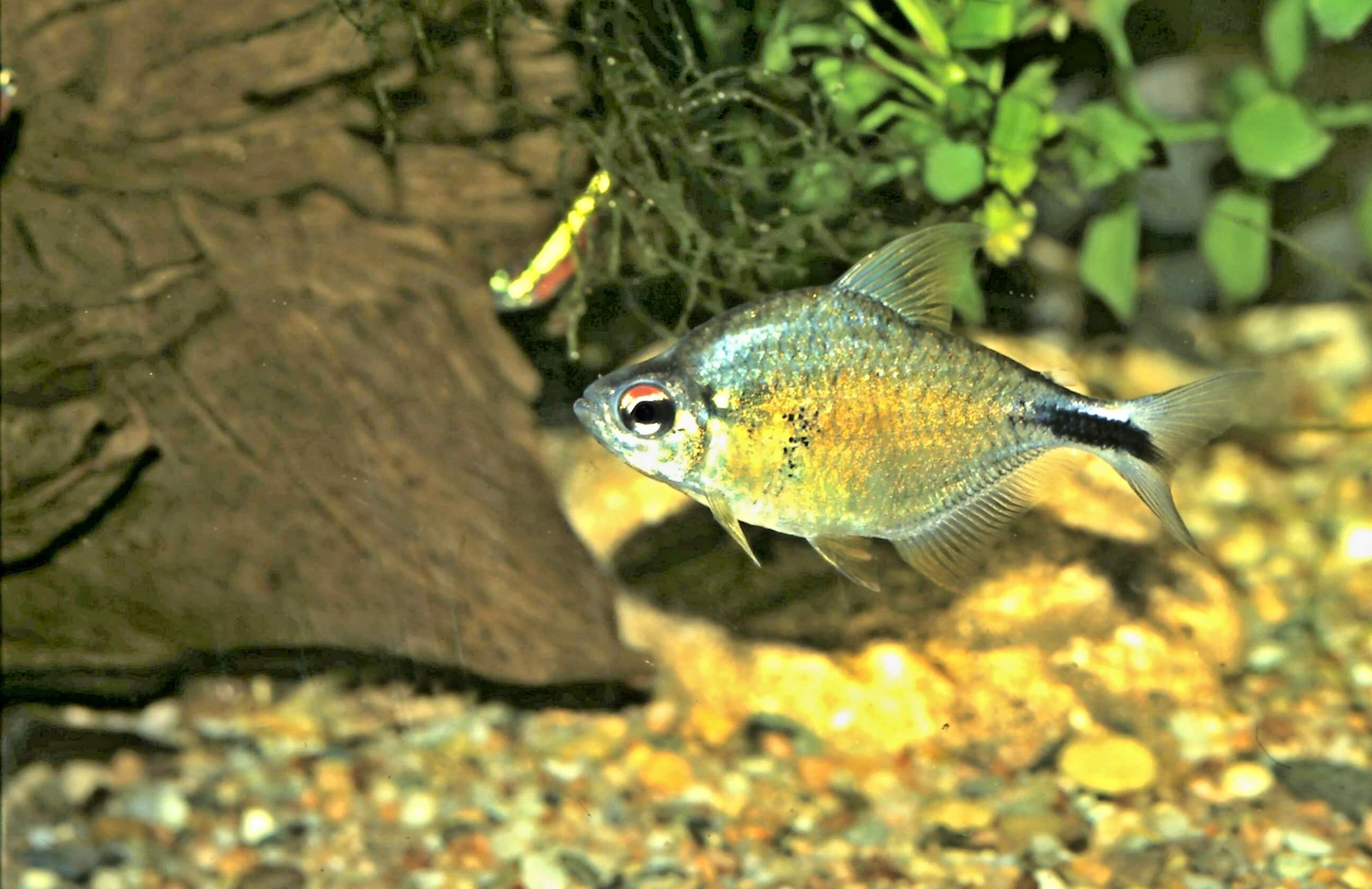
- Astyanax leopoldi – adult male.
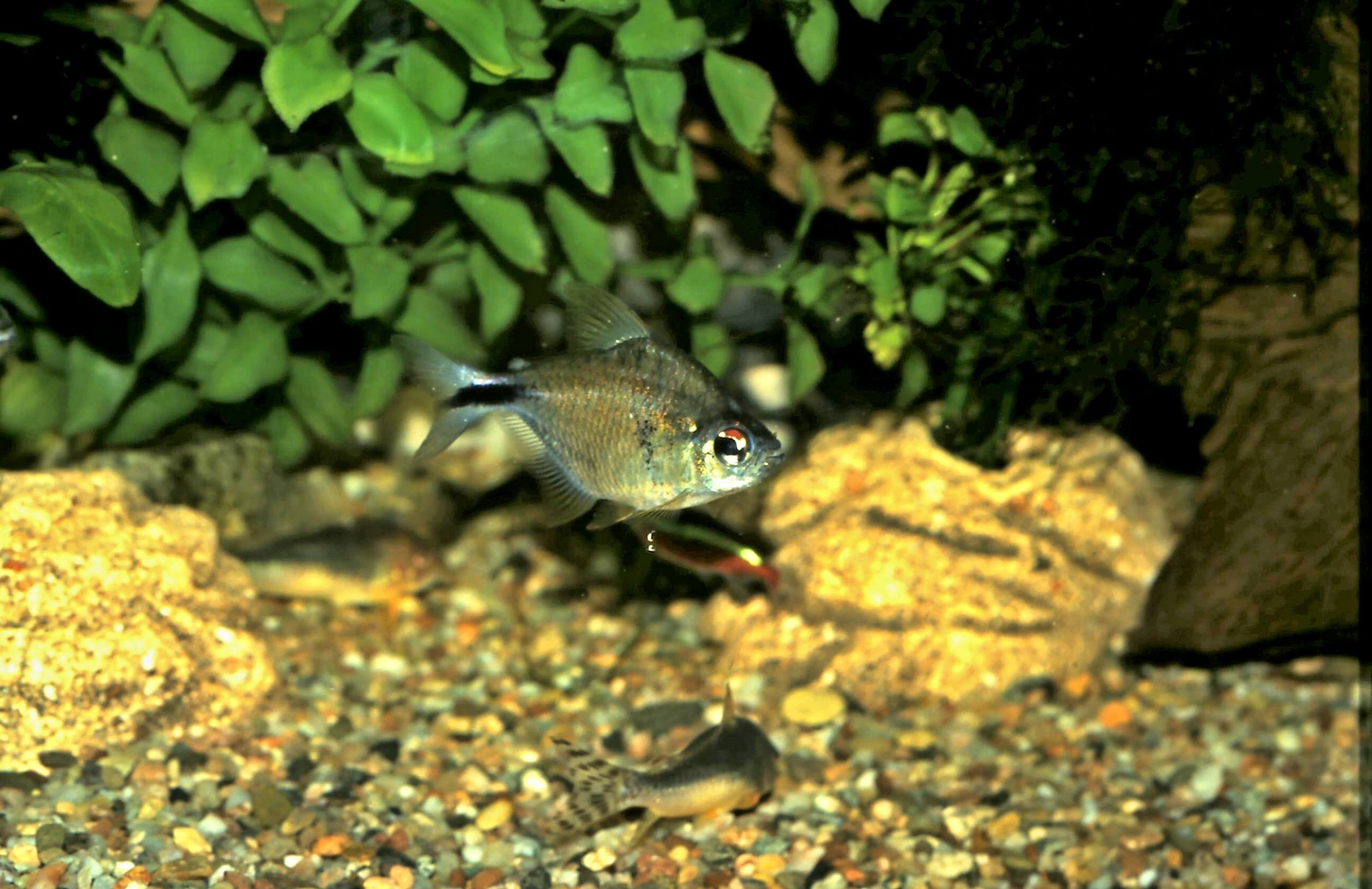
- Adult female.
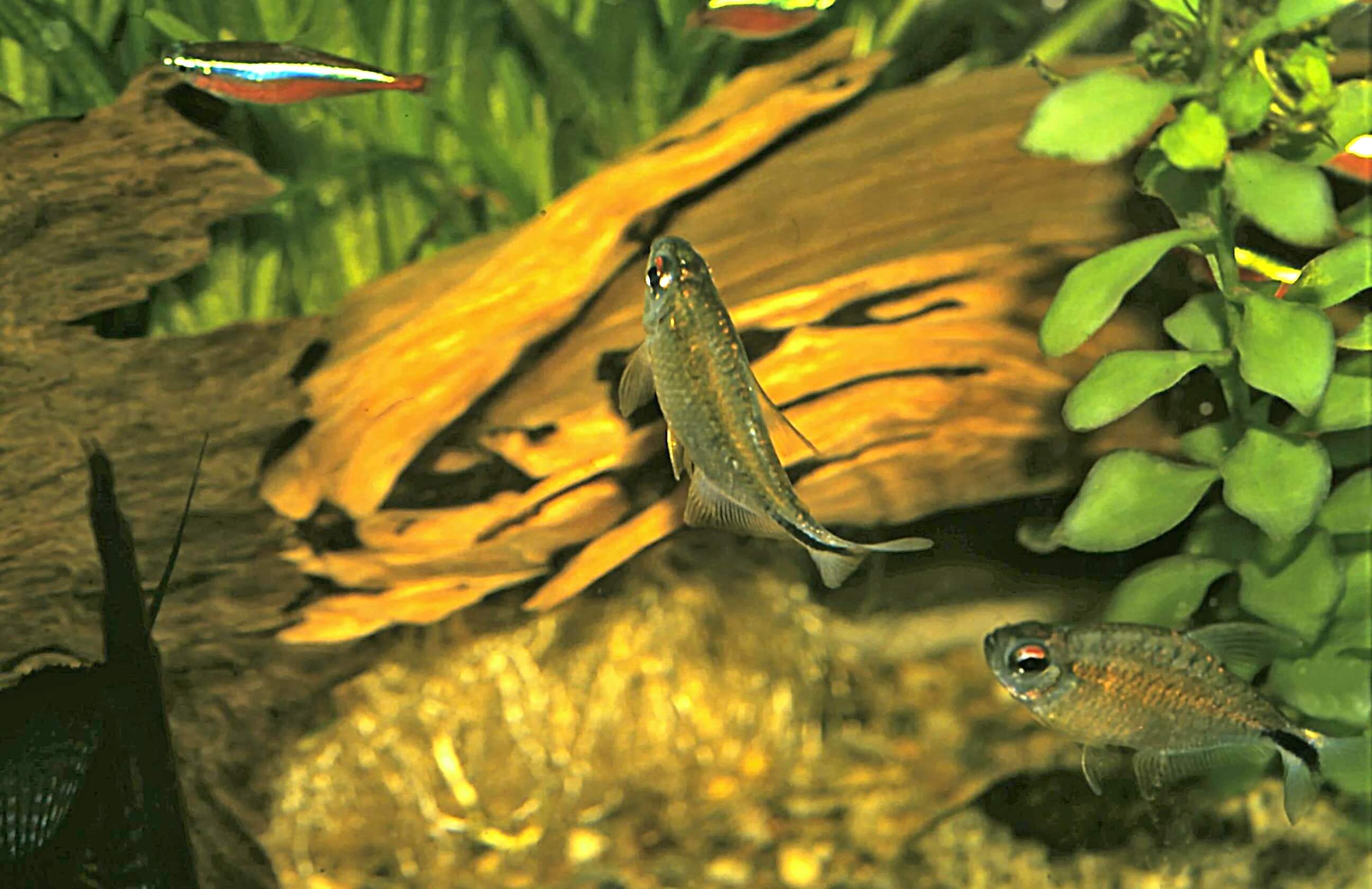
- A common phenomenon is the "chase" of Leopold's tetras. The sign of sexual maturity is also courtship; the males show interest in the females.
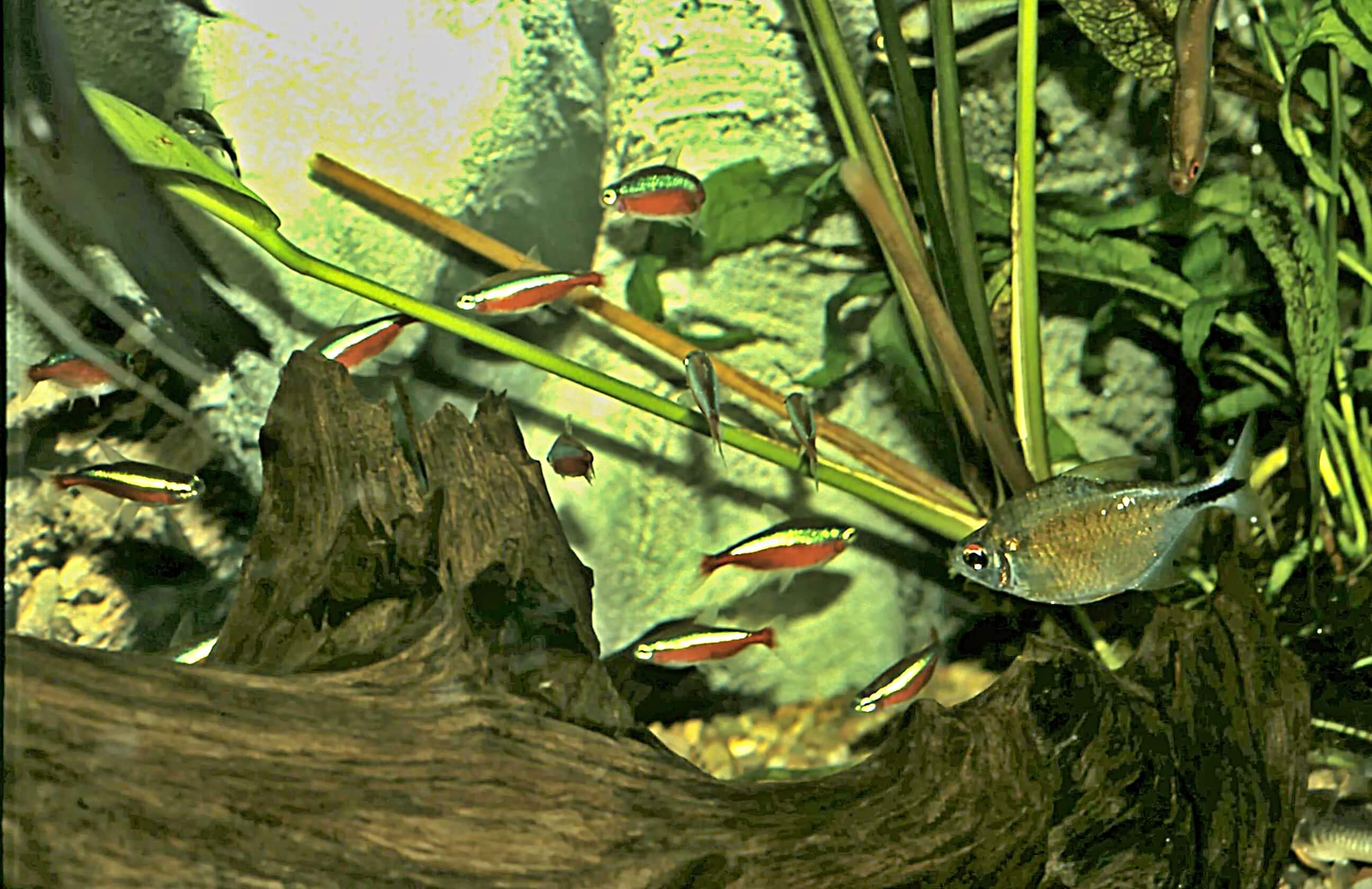
- Leopold's tetra is a great companion for small and peaceful tetras.