

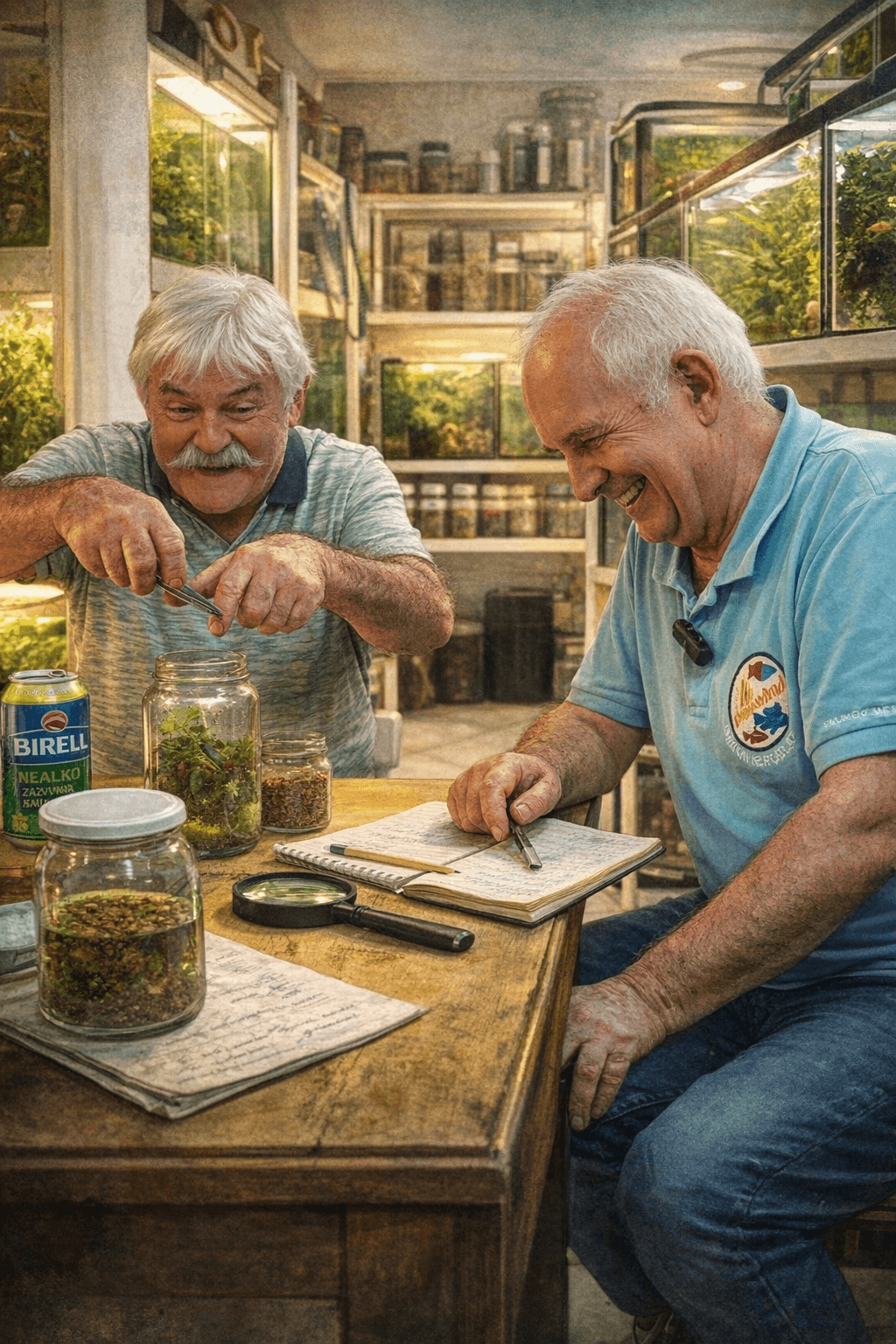
The Czech aquarium school has always been among the world's elite. However, its success in the past did not rely on academic titles, but on incredible patience, precise observation, and the intuition of people who approached fish from completely different professions. In the latest installment of our series, we will take a look into history, where breeding practices were passed on personally and where scientific Latin was the only way to communicate with the world.
Signature species as a lifelong passion
Every serious breeder has their aquarium "heartfish". For Slavek Boudný, it was Trichogaster (now Trichopodus). For Zdeněk Dočekal, it is precisely the red neon tetra, a fish whose first successful breeding in the days before the internet and mobile phones marked a significant turning point for a novice aquarist. In an era when immediate help was not available on discussion forums, advice was sought in person – for example, on a motorcycle, so that an experienced colleague could assist with determining the sex of the breeding pair. These initial successes with demanding species often launched a lifelong journey that led to professional export and international recognition.
Lessons in resilience: Genus Pseudosphromenus
In discussions about modern aquaristics, there is often a sigh about how beginners are discouraged by delicate species. Slavek Boudný therefore mentions his experience with the species Pseudosphromenus cupanus and Pseudosphromenus dayi. They are ideal "starter" fish. A fascinating story from breeding practice demonstrates their incredible resilience: a group of these fish managed to survive in a forgotten and neglected aquarium full of decaying plants and sludge for several weeks. Not only did they survive, but under these harsh conditions, they managed to breed without any care.
Such species – capable of withstanding beginners' mistakes and rewarding them with their own offspring – are key to raising a new generation of aquarists.
Latin nomenclature and the legacy of MVDr. František Csefay
One of the prominent topics of the discussion is the importance of Latin nomenclature. As emphasized by a significant figure in Czechoslovak aquaristics, MVDr. František Csefay:
Latin is not an expression of snobbery, but the only precise scientific language.
Common names can be misleading or even degrade the fish; as an example, it is noted that in Latin, the noble fish is known as Trichogaster labiosus. In local translations, the fish is seemingly degraded to "dwarf colisa" or "dwarf gourami." In the Czech designation, the fish thus receives an unflattering attribute.
Csefay, a veterinary professional, brought ethological observations and physiological analysis into Czech aquaristics. His findings on dietary specialization, supported by dissections and studies of intestinal lengths in African cichlids, remain a valid warning against unsuitable diets, which irreversibly damage these fish.
From worker to fame
A specific feature of Czech aquaristics is its origin in various fields. The personalities who shaped the history of this field were often from working-class professions: Josef Bradler – electrician, Josef Ešpander – sugar refiner, and yet pioneers in many breeding areas.
Turners and craftsmen, who could breed species considered problematic in the world even in poor conditions and with minimal equipment.
Zdeněk compares in an interview the relationship of aquarists to fish with actors who have never studied acting but excel in it, or with Romani bands:
they may not know the notes or (in the case of aquarists) have an education, but they have it in their heart and soul.
In conclusion
Aquaristics is not just about fish and technology: it is primarily about people and their stories. The current trend of "internet aquarists," who draw knowledge from anonymous discussions, often lacks the depth of personal experience and patient observation. The legacy of the generation that built this hobby on honest craftsmanship and mutual respect should be preserved as an inspiration for all who truly want to understand the world beneath the surface.
Slavek Boudný mentions his plan to write a book tentatively titled "This is Our Hobby," which should be precisely about these people and their stories.
The entire interview on YouTube (please don't forget to select the right subtitles):