


For the breeding of South American annuals (SAA) III: Rearing, care, and protection of rare killifish
This article provides in-depth insights into the successful breeding of South American annual killifish. It addresses the proper feeding of fry, the necessity of gender separation due to different growth rates, and offers solutions to the critical problem of "Bauchrutscher" (Bauchrutscher). Furthermore, strategies for controlling the sex ratio as well as early sex determination in species such as Argolebias and Austrolebias are described in detail. A particular focus is placed on the dramatic threat to their natural habitats due to urbanization and viticulture. The text concludes with recommendations for beginners (e.g., Argolebias nigripinnis) and encourages engagement in the breeding community.
Continuation of Part 2: A century of mistakes on the road to breeding success
Breeding
Once the young have hatched, they can immediately take in food. Our killifish do not go through a larval stage outside the egg. When selecting suitable food organisms, we base our choice on mouth size. Paramecium caudatum, micro or vinegar eels, as well as Artemia or appropriately sifted pond food are a good choice. Chopped or twisted Tubifex or earthworms should be given with caution, as they can quickly pollute the water.
Observations in nature suggest that small crustaceans are very beneficial for growth in most species. Adloff (1923 b) found a very large number of such small crustaceans in a water collection with young Megalebias wolterstorffi (formerly Austrolebias), which certainly served as food. Boschi (1957) reported on Austrolebias bellottii, that at certain collection sites, only Cladocerans of the genus Chydoridae or Hyalella were found in their digestive tract. In a 5.7 cm long specimen, 19 of these crustaceans and 3 small Ostracods were found. In practice, this means that the fish should be kept in a constant supply of food.
During growth, the different growth rates in both sexes become noticeable. Breeders often separate the young fish so that the females are not overly pressured. I find this to be the safest way to avoid losses. In any case, it is advisable to place a bowl with peat in the tank early on for the floating males. Once we have raised the females separately, they are gradually given to the males (Fröhlich 1972).
Numerous water changes support the breeding process. They seem to directly affect metabolism and help prevent diseases. If only soft water is available, it is advisable to harden the water for a certain period during breeding. The fish absorb substances from the water through their entire body surface, especially through the gills. Sufficiently large breeding aquariums compensate for the aggression of species that already show in the smallest young. Overall, breeding in large aquariums facilitates handling these species. I only partially fill the tanks and add a little water every day. Once the tank edge is reached, I drain the water and the cycle begins anew. The struggle for survival, the fight for the best food begins early.
Occasionally, mass die-offs of young fish are reported. I suspect Oodinium infections, which is very difficult to detect on the small animals. When treating with the relevant medications, precise dosing is crucial. Regular water changes help to prevent this.
Belly sliders
In the breeding of annual killifish, belly sliders occur repeatedly. They apparently cannot fill their swim bladders or do not fill them sufficiently and therefore cannot assume a normal swimming position. They cannot compensate for this lack of filling over time either. The principle of swim bladder filling has been studied for some fish species. Unfortunately, there are no research results for our killifish.
The question arises as to how to prevent hatchable embryos from becoming belly sliders. There are various suggestions for this with simultaneous success reports.
I use – like many other breeders – oxygen tablets. The company Dohse AQUARISTIK GmbH & Co. KG kindly explained upon my inquiry that one tablet of their hobby oxygen tablets provides about 30-35 mg of oxygen in 10 liters. The production of oxygen is triggered by a reaction of the contained substances in connection with water.
Cauvet (2011) uses peat water for the infusion and has not had any belly sliders since then. He confirmed this based on his observations with other species of South American annuals, but also with other genera such as Nothobranchius and Callopanchax. He adds a bit of brown water to pure rainwater, which has stood for a longer time on flocculent peat or which is obtained by soaking peat tablets. He adopted the method from Dan Katz and Curt Smith, who proceed similarly in the USA.
Breeding requires two...
A problem in the breeding of some killifish species is the unequal sex ratio - a problem that can only be hinted at here. It goes without saying that a number of broods with a strongly predominant sex can discourage the hobbyist from further keeping them. It is worthwhile to try different water temperatures, different pH values, frequent attempts with different animals, and at different times of the year (thus at different water temperatures) to address this phenomenon. It is not uncommon to find a breeder who has raised his young with the opposite result. In such cases, an exchange is highly recommended. The internet serves as a reunion platform.
Not a few enthusiasts have reported that two separately raised young fish surprisingly formed a pair. I have also had this experience. With the accumulation of these reports, we no longer believe in coincidence.
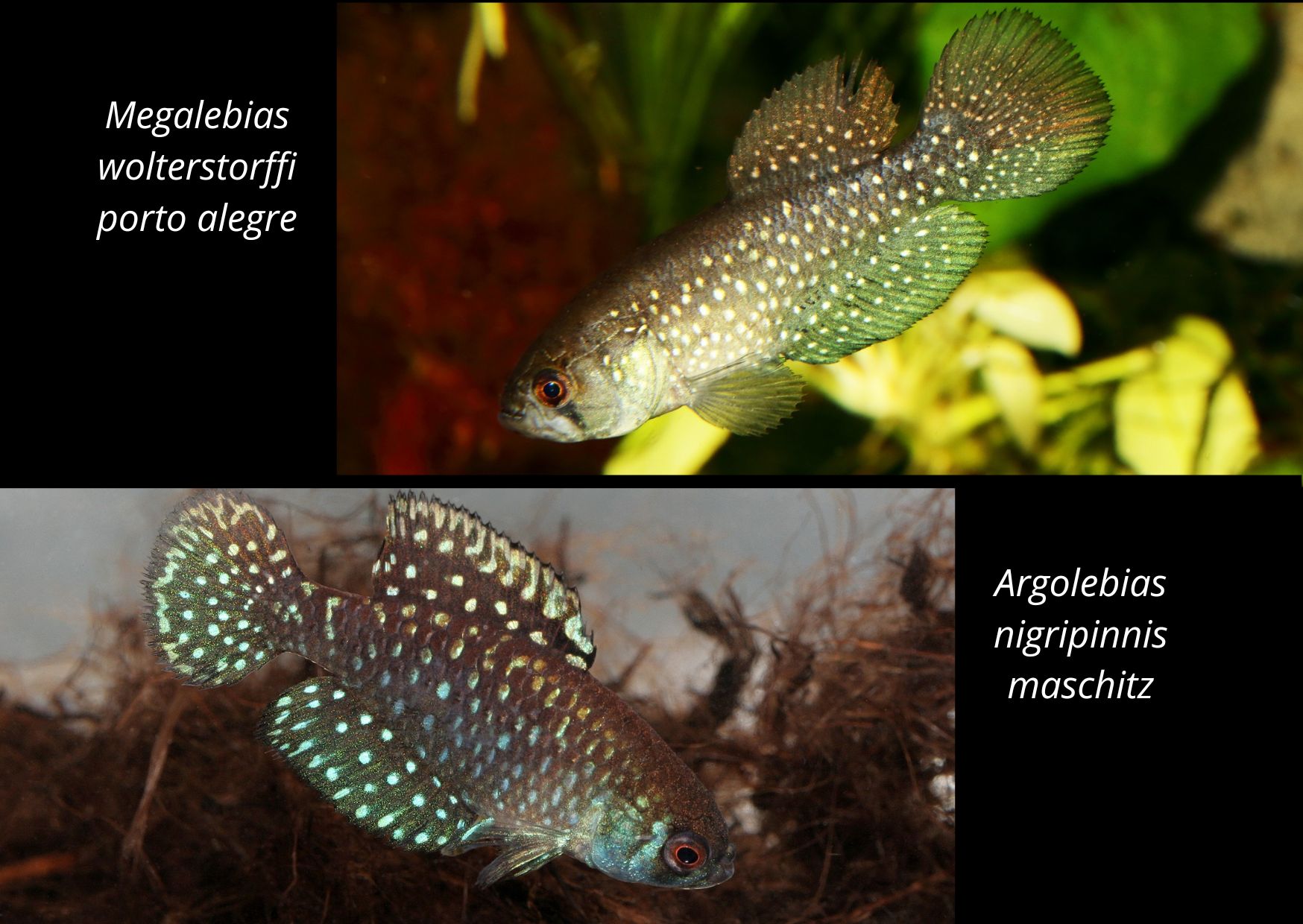
Additionally, it is complicated that in some species it takes relatively long before the sexes can be determined. We must therefore raise the entire brood until we have clarity. In Argolebias nigripinnis, the different sexes could already be distinguished by their different pigmentation after 12 to 14 days. In Garcialebias adloffi (formerly Austrolebias), we see the differences at a size of about 2.5 cm, while in Austrolebias elongatus unfortunately only from 6 – 7 cm (Foersch 1956, 1978). In my experience, the partly different numbers of fin rays in the dorsal fin can give an impression of the expected sex, even if counting at this size is difficult. There is still the option of using the photo function of the mobile phone...
Threat to habitats
The sculptor Alfred Adloff lived at the beginning of the last century in Porto Alegre, Brazil, and reported to the editor of the journal for aquarium and terrarium science (Wolterstorff) about the then still undescribed Megalebias wolterstorffi, that young had emerged without draining (Adloff 1923b). In these reports, he lamented that many water bodies were filled in and used for construction. “Just like with us!” Wolterstorff noted back then. Even after a hundred years, the principle has not changed. In the meantime, Costa (2017) found during a visit to the type locality of Hypsolebias splendissimus, that it had been filled with soil (Costa et al 2018). Nielsen (2000), a Brazilian scientist and aquarist, pointed out how severely the living conditions of species from the genera Campellolebias, Cynolebias, Hypsolebias and Leptolebias are threatened in his homeland. Costa (2012b) saw the then 12 species of South American annuals known from the coastal plain of Rio de Janeiro on the brink of survival. Regarding the genus Nematolebias, Costa et al. (2014) lamented shortly thereafter the threat to habitats due to rampant urbanization. But that is not all.
In connection with the 2014 FIFA World Cup in Brazil, Brazilian wine made headlines. Wine consumers were not disappointed by the quality. This was probably the message that the winemakers from the subtropical south of the border to Uruguay wanted to convey. Unfortunately, the wine culture in Brazil has now also expanded to the northeastern regions. This significantly threatens the distribution areas of the South American annuals. Costa has early on drawn attention to the wine-growing area that has developed in the lower basin of the Rio São Francisco and the threat it poses to endemic species (Costa 2012a).
Studies on populations of Hypsolebias antenori show the threat posed by urbanization, agriculture, and the ceramics industry (Nascimento et al.. 2015). With all the reports on the threat to species, it is not surprising that studies have shown that Megalebias wolterstorffi is also endangered in its limited occurrence in southern Brazil and Uruguay (Garcez et al. 2018). The outlook for these fish species is not good.
Avoiding diseases
In the previous chapters, I was able to outline some key points regarding the size of aquariums, the water used, the setup, the cohabitation, and the technical aids for keeping and breeding. We must be clear that conditions deviating from their needs cause stress in the fish. This increases the risk of them becoming infected with diseases. It helps the fish if we regularly check the keeping conditions and take precautions. And this helps us because addressing an illness requires effort and time.
Initially, a quarantine for the acquired fish is important. Because the time when a fish is caught and brought to another aquarium means a lot of stress and all possible reasons why a disease could break out.
Preventive measures include water maintenance tailored to the conditions such as tank size, stocking, amount of food, filter, etc.
Our South American annuals tempt collectors due to their large number of species. Several aquariums can quickly be filled with beautiful fish. It gets cramped at the latest when the first good breeding results are achieved. Especially under these circumstances, but actually in any situation, we should keep hygiene in the tanks and in the facility in mind. In my article on Glugea , I have elaborated on this extensively in the aquarium specialist magazine No. 275.
The species move in with us
After you have learned so many details about the South American annuals, you will surely want to try keeping one of the species. Argolebias nigripinnis is the classic beginner species. Because of its relatively short incubation period, Hypsolebias magnificus is also recommended for beginners. The species offering is wide-ranging.
Perhaps you can get in touch with a breeder. This can be done via the internet or the respective killifish community. For these fish species, which can reach an age of one to three years, it is sensible for aspiring breeders to obtain young animals. When exchanging with the breeder, you also receive free tips as a bonus. It is also quite common to send South American annuals as peat spawn by post. The previously mentioned sources also help here. There is also Aquabid, a platform where peat spawns can be auctioned. You don’t have to start with the seemingly most expensive offer right away. There are also affordable species.
If you have received fish, they must be acclimated gently. The newcomers are acclimated to the future holding water by gradually scooping water from the future home into the plastic bags. This takes time. I would recommend checking on the fish during the waiting periods. Even better would be to place them directly with the transport water in small containers or additional plastic bags and separate the sexes. And then it can begin.
The South American annuals are rare. Therefore, a kind of sworn community has formed that helps each other. Naturally, it promotes the exchange of species if we know approximately the species kept through inventory lists. We talk a lot about our fish. Let yourself be inspired and start breeding.
Literature
- Adloff, A. (1923a): News from Cynolebias adloffi Ahl. Blätter 34(1): 1 - 3.
- Adloff, A. (1923b): Letter from Brazil. News from Cynolebias et al. Blätter 34(12): 251 - 252.
- Barois, Nibia et al. (2016): Annual Fishes. Life History Strategy, Diversity, and Evolution. - CRC Press - Taylor & Francis Group, Boca Raton, FL 33487-2742.
- Bela, Heinz (1982): Cynolebias constanciae Myers, 1942. DKG-J. 14(7): 104-106.
- Belote, D. F. & Costa, W. J. E. M. (2002): Reproductive behavior patterns in the neotropical annual fish genus Simpsonichthys Carvalho, 1959 (Cyprinodontiformes, Rivulidae): Description and phylogenetic implications. - Bol. Mus. Nac. 489: 1-10.
- Belote, D. F. & Costa, W. J. E. M. (2003): Reproductive behavior of the Brazilian annual fish Cynolebias albipunctatus Costa & Brasil, 1991 (Teleostei, Cyprinodontiformes, Rivulidae) a new report of sound production in fishes. - Arquivos do Museu Nacional, Rio de Janeiro 61(4):.241-244.
- Berg, Carlos (1897): Contributions to the knowledge of South American fishes, especially those of the Republic of Argentina. An. Mus. Nac. de Buenos Aires V: 263-302. (not viewed)
- Boschi, Enrique (1957): Argentine pearl fish. - T. F.H. Publ. Inc., Jersey City, N. J., 23 pages.
- Brüning, Christian (1912): Pocket calendar for aquarium enthusiasts. - Gustav Wenzel & Sohn, Braunschweig. 96 pages.
- Brüning, Christian (1913): Pocket calendar for aquarium enthusiasts. - Gustav Wenzel & Sohn, Braunschweig. 122 pages.
- Brüning, Christian (1914): Pocket calendar for aquarium enthusiasts. - Gustav Wenzel & Sohn, Braunschweig. 133 pages.
- Calviño, Pablo A., Alonso, Felipe & de Torres, Jorge Sanjuán (2007): Filling of gas in the swim bladder of post-larvae of South American annual fish (Cyprinodontiformes; Rivulidae). - Bulletin of the Killi Club Argentino BIBKCA No. 13: 18-39.
- Cauvet, Christian (2011): Patience and length of time. An incubation experience of the eggs of annual killies with Simpsonichthys magnificus. - KR 1/2011: 14-20.
- Costa, W. J. E. M. (1990a): Phylogenetic analysis of the family Rivulidae (Cyprinodontiformes, Aplocheiloidei). - Rev. Brasil. Biol. 50(1): 65-82.
- Costa, W. J. E. M. (1990b): Classification and distribution of the family Rivulidae ((Cyprinodontiformes, Aplocheiloidei). - Rev. Brasil. Biol. 50(1): 83-89.
- Costa, W. J. E. M. (1995): Revision of the neotropical annual fish genus Campellolebias (Cyprinodontiformes: Rivulidae), with notes on phylogeny and biogeography of the Cynopoecilina. - Cymbium 19: 349-369
- Costa, W. J. E. M. (2011): Comparative morphology, phylogenetic relationships, and historical biogeography of plesiolebiasine seasonal killifishes (Teleostei: Cyprinodontiformes: Rivulidae). - Zoological Journal of the Linnean Society, 2011(162): 131–148.
- Costa, W. J. E. M. (2011b): Hypsolebias nudiorbitatus, a new seasonal killifish from the Caatinga of northeastern Brazil, Itapicuru River basin (Cyprinodontiformes: Rivulidae). - IEF 22(3): 221-226.
- Costa, W.J.E.M. (2012a): Diversity and conservation of killifishes of the Brazilian Caatinga. - Killi-News No. 549: 73-82.
- Costa, W.J.E.M. (2012b): Delimiting priorities while biodiversity is lost: Rio’s seasonal killifishes on the edge of survival. - Biodivers Conserv 21:2443–2452.
- Costa, Wilson J. E. M.; Pedro F. Amorim and Giulia N. Aranha (2014): Species limits and DNA barcodes in Nematolebias, a genus of seasonal killifishes threatened with extinction from the Atlantic Forest of southeastern Brazil, with description of a new species (Teleostei: Rivulidae). - Ichthyol. Explor. Freshwaters 24(3): 225-236.
- Wilson J. E. M. Costa (2014): Six new species of seasonal killifishes of the genus Cynolebias from the São Francisco river basin Brazilian Caatinga, with notes on C. porosus (Cyprinodontiformes: Rivulidae). - Ichthyol. Explor. Freshwaters 25(1): 79-96.
- Dahl, George (1958): Two new annual cyprinodont fishes from northern Colombia. - Stanford ichthyological bulletin 7(3): 42-46.
- Costa, Wilson J.E.M., Amorim, Pedro F. &. Mattos, José Leonardo O (2018): Diversity and conservation of seasonal killifishes of the Hypsolebias fulminantis complex from a Caatinga semiarid upland plateau, São Francisco River basin, northeastern Brazil (Cyprinodontiformes, Aplocheilidae). - Zoosyst. Evol. 94 (2) 2018, 495–504.
- Eigenmann, Carl H. (1907): The poeciliid fishes of Rio Grande do Sul and the La Plata basin. - Proc. US Nat. Mus. 32(1532): 425-433.
- de Greef, Jaap-Jan (1993): Belly sliders: A problem or not. AguaTropica 2(3): 3-4, 1993
- Hagenmaier, Hans E. (1995): The enzymatic hatching of fish. pp. 101-113 in: Reproductive biology of aquarium fish. Birgit Schmettkamp Verlag.
- Foersch, W. (1956a). Care and breeding of Cynolebias nigripinnis. DATZ 9(2): 35-39.
- Foersch, W. (1956b): Observations on the behavior and egg development of bottom-spawning fish. – Z. für Vivaristik 2: 8–13, 39–45, 113–117, 177–184.
- Foersch, W. (1958): Observations and experiences in the care and breeding of Cynolebias ladigesi Myers. - DATZ 11(9): 257-260
- Foersch, Walter (1961): Cynolebias (Cynopoecilus) ladigesi. - Tropische Fische 1(9): 396-404.
- Foersch, Walter (1975): The “fighting gaucho” dances around its female. Breeding and care of Cynolebias ladigesi and melanotaenia. AM 9(10): 404 – 409.
- Foersch, Walter (1978): How does the elongated fanfish spawn? Observations in the care and breeding of Cynolebias elongatus. - AM 12(2): 86-93.
- Fröhlich, Fritz (1972): Some observations on the breeding of Cynolebias species. - DKG-J. 4(1): 1-4.
- Garcez, Daiana K.; Barbosa, Crislaine; Loureiro, Marcelo; Volcan, Matheus V.; Loebmann, Daniel; Quintela, Fernando M. & Robe, Lizandra J. (2018): Phylogeography of the critically endangered neotropical annual fish, Austrolebias wolterstorffi (Cyprinodontiformes: Aplocheilidae): genetic and morphometric evidence of a new species complex. - Environ Biol Fish.
- García, Daniel; Loureiro, Marcelo & Tassino Bettina (2008): Reproductive behavior in the annual fish Austrolebias reicherti Loureiro & García 2004 (Cyprinodontiformes: Rivulidae). - Neotropical Ichthyology, 6(2):243-248.
- Johannis, M. & Köpp, C. (2015): Fish that fell from the sky. - Amazonas 11(6 No. 62): 14-22
- Langton, Roger W. (1979): A Numbering System to Indicate Peat Moss Wetness. - JAKA 12(6): 187-188. Reprint 1989 in JAKA 22(6) 193-194.
- Laufer, Gabriel et al. (2009): Diet of four annual killifishes: an intra and interspecific comparison. - Neotropical Ichthyology 7(1):77-86.
- Liu & Walford: Laboratory Studies on Life-span, Growth, Aging, and Pathology of the
- 1969] Annual Fish, Cynobelias bellottii Steindacher 7
- Loureiro, Marcelo; Sá, Rafael de 2; Serra, Sebastián W.; Alonso, Felipe; Lanés, Luis Esteban Krause; Volcan, Matheus Vieira; Calviño, Pablo; Nielsen, Dalton; Duarte, Alejandro; Garcia, Graciela (2018): Review of the family Rivulidae (Cyprinodontiformes, Aplocheiloidei) and a molecular and morphological phylogeny of the annual fish genus Austrolebias Costa 1998. - Neotropical Ichthyology, 16(3): e180007:1-20
- Meder, Dr. E. (1953a): Cynolebias bellottii Steindachner. - DATZ 6(7): 169 - 172.
- Meder, Dr. E. (1953b): Cynolebias bellottii Steindachner (considering Cynolebias nigripinnis Regan). DATZ 6(8): 197 - 201.
- Nascimento, WS, Yamamoto, ME.b, Chellappa, NT.c, Rocha, O.d and Chellappa, S. (2015): Conservation status of an endangered annual fish Hypsolebias antenori (Rivulidae) from Northeastern Brazil. - Braz. J. Biol. 75(2): 484-490.
- Nielsen, Dalton (2000): Saving the Killies of Brazil. - KR 05/200 November 2000: 16-19
- Nielsen, Dalton T. B. & Brousseau, Roger (2014): Description of a new annual fish, Papiliolebias ashleyae (Cyprinodontiformes: Rivulidae) from the upper Rio Mamoré basin, Bolivia. - aqua, International Journal of Ichthyology 20(1): 53-59.
- Nieuwenhuizen, A.v.d. (1977): Cynolebias alexandri. DATZ 30(11): 364 – 369.
- Ott, Dieter (1996): Cynolebias affinis or: How do I breed Annual Killifish? - Agua tropica2 1(6): 5-7.
- Ott, Dieter (2020): Fascination Aphyos - Successfully keeping and breeding ornamental killifish. - VerlagsKG Wolf, 272 pages.
- Peters,N. (1963): Embryonic adaptations of oviparous toothcarps from periodically drying waters. - Int. Rev. ges. Hydrohiol., 48: 257-313.
- Pillet, Didier (2008): Brazilian walks. Observations and measurements in the temporary ponds of the Cerrado and the Brazilian coast. - KR 03/2008 May/June 2008: 5-15
- Pillet, Didier (2013): Tips for successfully dealing with annual fish eggs. - KR 1/2013: 17-22
- Rachow, (1912): Is Cynolebias maculatus Steind. the female of Cynolebias bellottii Steind.? – Blätter 23(52): 835-838.
- Regan, C. Tate (1912a): A Revision of the Poeciliid Fishes of the Genus Rivulus, Pterolebias and Cynolebias. - Ann. And Mag. Of Natural History 8(10): 494.
- Regan, C. Tate (1912b): Sexual differences in the Poeciliid Fishes of the Genus Cynolebias. - Ann. Mag. Nat. Hist. 10: 641-642.
- Rosskopf, Christian (2004): Clay as spawning substrate for South American bottom spawners. – DKG-J. 36(5): 131 -139.
- Schwarz, Rich. (1918): Cynolebias belotti Steindachner. - Wochenschrift 15(3): 19-21.
- Siegel, G. (1958): Interesting news about bottom-spawning South American toothcarps. - DATZ 11(7): 200-202.
- Seegers, Lothar (1979): Cynolebias bellottii: Historically, scientifically, and aquaristically considered. - aquarien magazin 13(2): 78-83.
- Seegers, Lothar (1980): Cynolebias alexandri and some observations on the existence of Cynolebias gibberosus. - DA October 1980 No. 136: 506-513.
- Seegers, Lothar (2000a): Campellolebias – Killifish with internal fertilization. - Aquarium heute 18(3): 584-587.
- Seegers, Lothar (2000b): Fan killifishes from South America. - AF 32(2 No. 152): 30-34.
- Siegel, G. (1958): Interesting news about bottom-spawning South American toothcarps. - DATZ 11(7): 200-202.
- Stansch, K. (1914): The exotic ornamental fish in word and image. - Verlag Vereinigte Zierfischzuchten Rahnsdorfer Mühle near Berlin. 349 pages.
- Steinberg, Christian (2011) The brackish water killifish, Fundulus heteroclitus – Model for epigenetics and evolution. - AF 43(1 No. 217): 62-66.
- Steindachner,76. Arch. Soco Biol. Montevideo, 26: 44-49.- 19Mb. Three new species of the genus Cynolebias STEINDACHNEI1l8, 76 (Teleostomi, Cyprinodontidae). Como Zool. Mus. Hist. Nat. Montevideo, 8: (I02'): 1-36, 6 pIs.
- Thomas, Karl (1938): All sorts of interesting things about Cynolebias bellotti. - W30(34): 537-539.
- Thomerson, Jim & Taphorn, Don (1992): The annual killifishes of Venezuela. Part 1: Maracaibo basin and coastal plain species. - TFH 41(1): 71-96
- Vaz Ferreira, R., Sierra, B. & Scaglia de Paulete, S. S. (1963): Hatching and
- subterranean retrograde tail propulsion of postlarvae of Cynolebias (Pisces, Cyprinodontidae) Neotrópica 9 (30), 111-112 – not viewed.
- Wildekamp, R. H. (1995): A world of killies. Atlas of the oviparous cyprinodontiform fishes of the world.
- Volume 2. – American Killifish Association, Mishawaka, Ind., 384 pp.
- wordlfish wiki (2025): https://www.wf-wiki.de/index.php?title=Cynolebiidae viewed 2025).
- Wourms, J. P. (1964): Comparative observations on the early embryology of Nothobranchius taeniopygus (Hilgendorf) and Aplocheilichthys pumilis (Boulenger) with special reference to the problem of naturally occurring embryonic diapause in teleost fishes. – In: East African Freshwater Fisheries Research Organization, Annual Report for 1964, Jinja, 68–73
- Wourms, J. P. (1972): Developmental biology of annual fishes. III: Pre-embryonic and embryonic diapause of variable duration in the eggs of annual fishes. – JEZ 182 (3): 389–414.