Bladderwort: aquatic plant that captures prey by suction
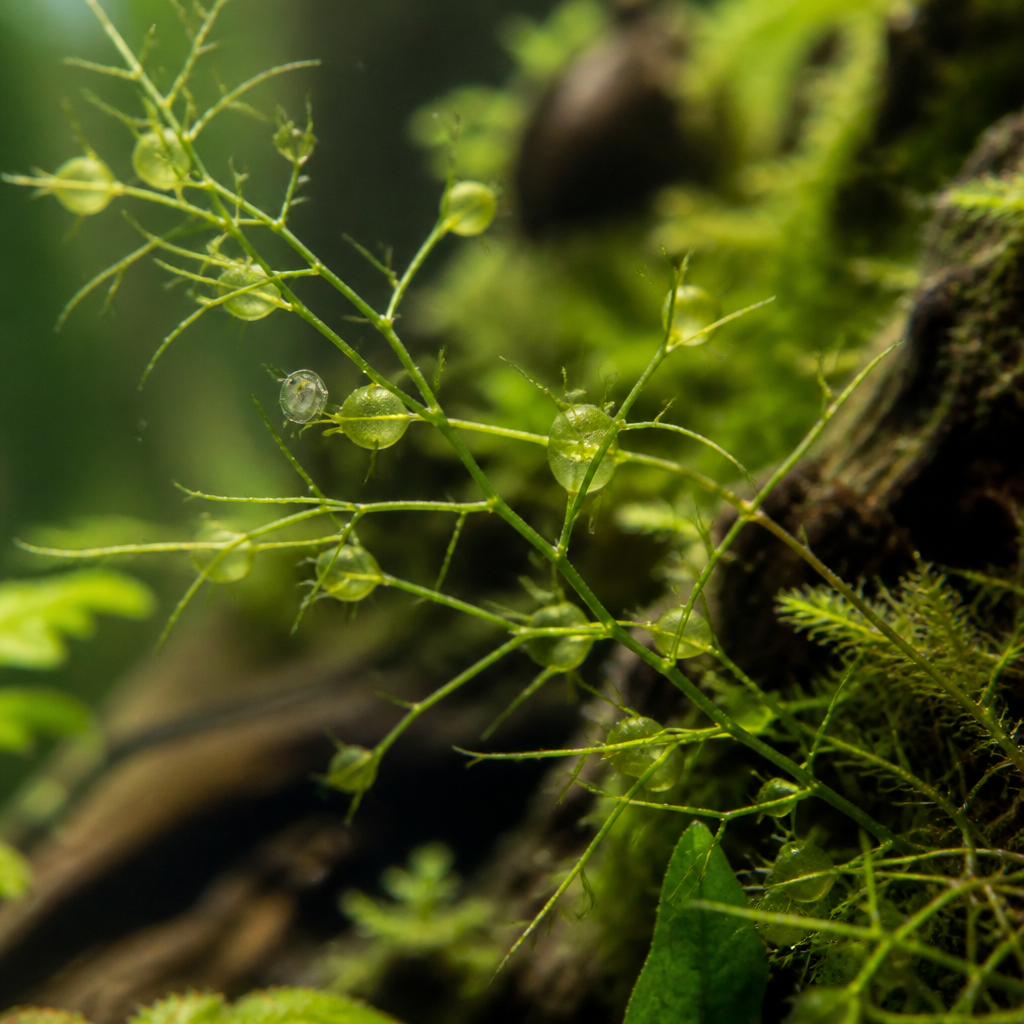
In an aquarium, you may notice it as a delicate, branching plant without obvious roots. On its submerged parts, tiny bladders – traps – hide, which is how bladderwort got its name. Some species of the genus Utricularia are aquatic carnivorous plants; their prey consists of very small aquatic animals.
The trap is first prepared
Bladderwort does not hunt by simply opening the bladder and waiting. Scientific studies on the examined species describe the opposite process: the plant first slowly drains water from the trap. This creates lower pressure inside than in the surrounding water, and the walls of the bladder stretch elastically. The trap is ready for use.
At the entrance to the bladder are doors and sensitive hairs. When a small animal touches them, the doors open, and the surrounding water rushes in – along with the prey. In Utricularia stellaris, scientists measured the opening of the doors at 300 to 700 microseconds. This is a result for a specific studied species, not a universal value for all bladderworts.
What does it mean in the aquarium?
The trap is tiny, so it is not a plant that would capture common adult aquarium fish. It is more suited for small prey: the expert guide from the Missouri Department of Conservation mentions small crustaceans, insect larvae, and newly hatched fish fry. Therefore, bladderwort is interesting for a tank where you raise fry or maintain small live food, but it is worth observing how it behaves.
This does not mean that every species of bladderwort will capture all these animals or that their presence in the aquarium will automatically threaten breeding. Traps and their prey vary, and laboratory observations cannot be directly transferred to every tank. For the aquarist, the main point is that hunting can occur among the delicate leaves, which is nearly invisible to the naked eye.
It is also a reminder that a plant in the aquarium does not have to be just a passive hiding place or decoration. In bladderwort, part of its modified leaf structure has turned into an active trap – a tiny mechanism that slowly charges and triggers at the moment of contact.