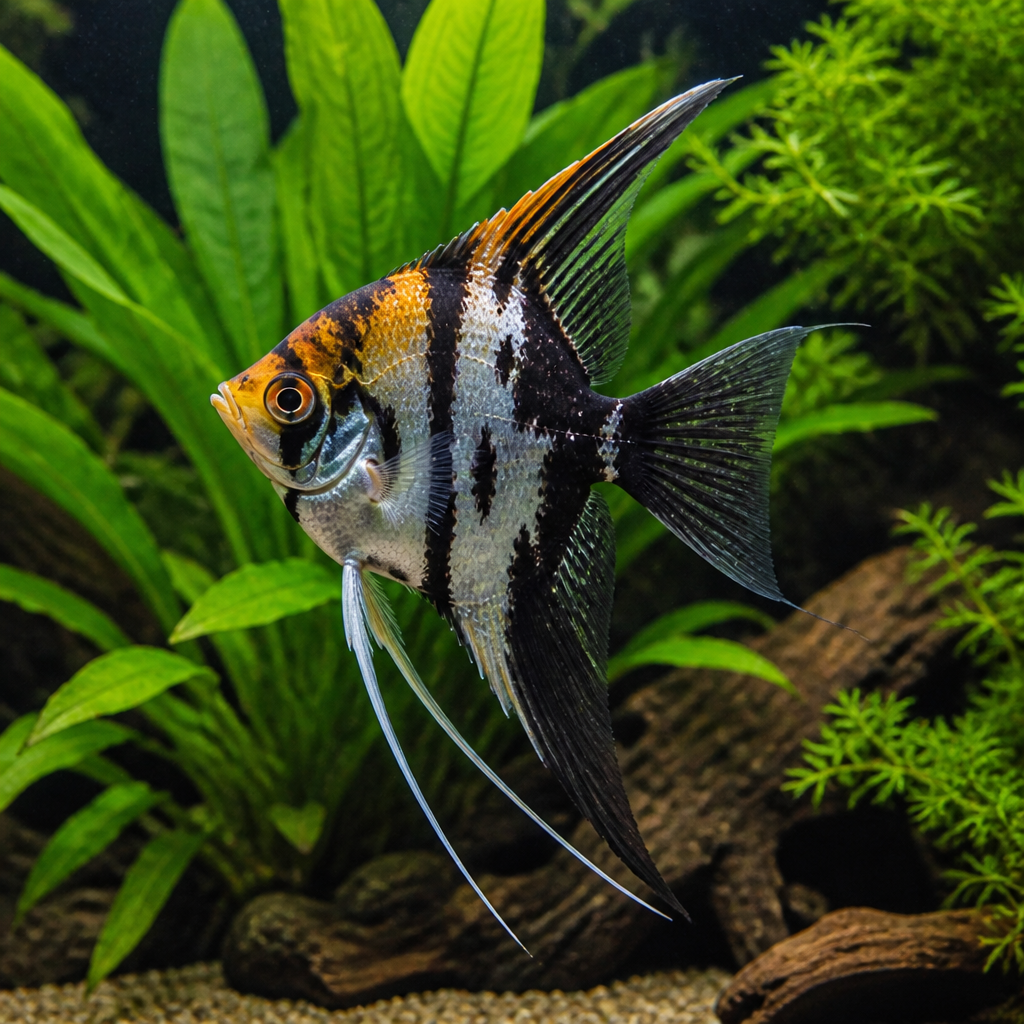
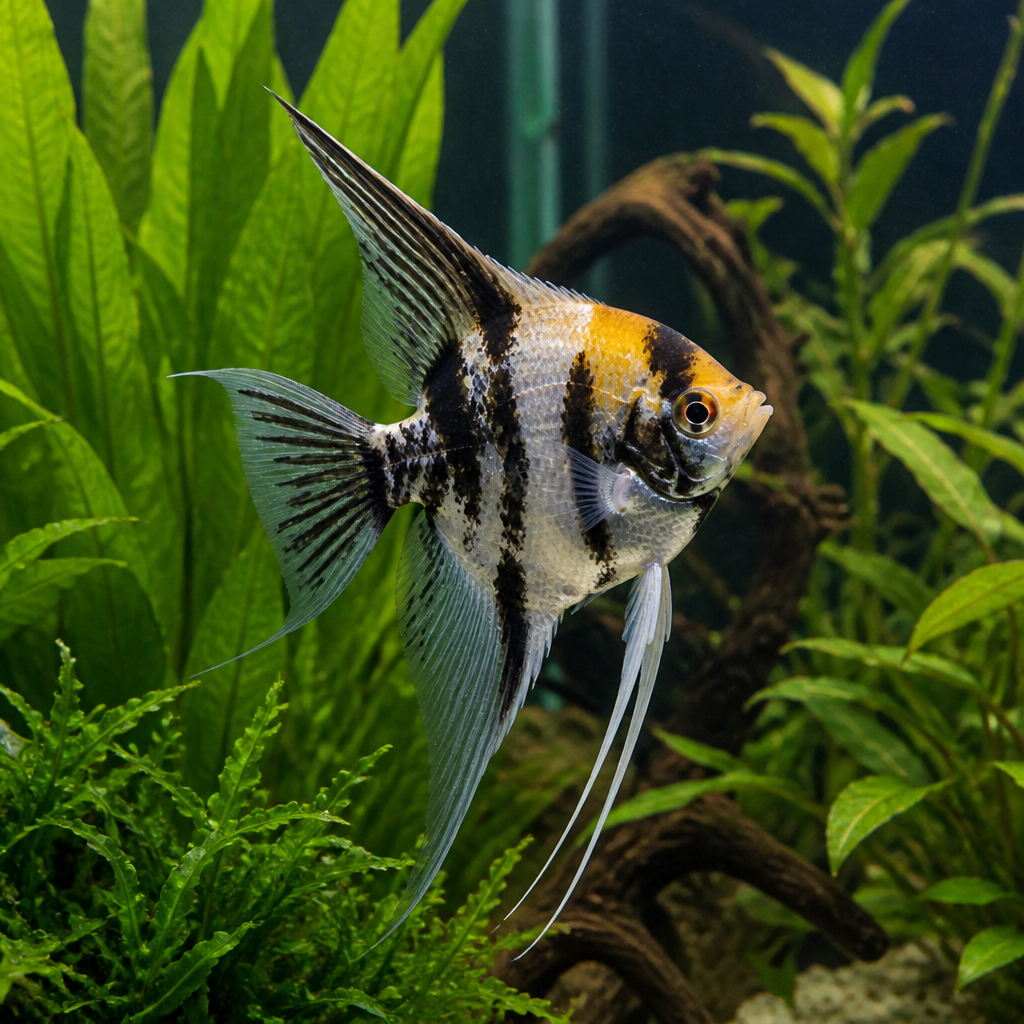

Has the behavior of your angelfish changed?
Two angelfish that previously swam peacefully among the plants suddenly chase away other fish from a single leaf. This is often not a sudden intolerance, but the beginning of breeding. Pair bonding and care for offspring are among the most interesting aspects of their keeping.
The Amazonian angelfish (Pterophyllum scalare) may appear calm, but during breeding, it can assertively signal its surroundings where free space ends. A chosen leaf or other surface becomes a place for eggs, and the surrounding area gains special significance for the pair. Territorial behavior in this situation is described by scientific observations and the experiences of breeders.
Interestingly, angelfish do not only defend their offspring. Experiments with intruders of the same species have shown that aggression is also related to the presence of a partner. Authors interpret this, among other things, as a possible protection of the pair bond from other angelfish. A seemingly trivial dispute at the leaf can thus have a more complex cause than mere defense of the eggs.
However, even a formed pair does not necessarily mean a lifelong partnership, as sometimes partner exchanges occur between breeding cycles.
Two angelfish bought together may not be a well-matched pair. Distinguishing between sexes can be difficult, and breeders often let pairs form within a group of adolescent fish. This approach, however, requires sufficient space and a pre-prepared solution for individuals that begin to be pushed out after a pair is formed.
During spawning, angelfish lay eggs on a substrate, such as a broad leaf, slate, or glass. Care does not end with mere guarding. Parents fan the eggs with their fins, thus renewing the water flow around them. In studies of parental behavior, experienced males significantly contributed to care, and their activity was associated with higher offspring survival. It is therefore incorrect to view male angelfish merely as fish that fertilize the eggs and then have no further role.
From this, a practical principle for setting up the aquarium follows: think about space for adult fish and the possibility for them to avoid each other. Tall plants and appropriately placed roots can divide the tank and limit direct visibility between its parts. Angelfish also need height; the mere volume of the tank is therefore not sufficient.
When forming a pair, pay particular attention to the other inhabitants of your aquarium. A brief chase away from the spawn is different from continuous harassment of a fish that cannot feed or leave a corner. In such a situation, safe separation of the fish is warranted, and one should not wait for possible injuries.
Sources used
- Cacho, Yamamoto, and Chellappa (2007): Mating system of the Amazonian cichlid angel fish, Pterophyllum scalare.
- Cacho, Chellappa, and Yamamoto (2006): Reproductive success and female preference in the Amazonian cichlid angel fish, Pterophyllum scalare.
- Seriously Fish: Pterophyllum “scalare” — breeding and reproduction.