

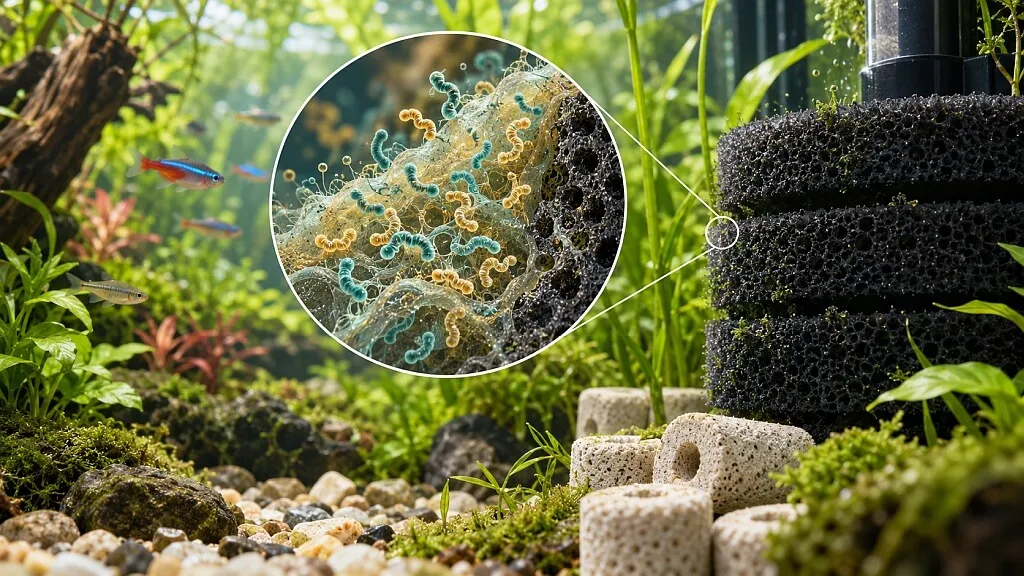
Biological filtration - a surprise inside the aquarium filter
Biological filtration is typically explained as the collaboration of two groups of microorganisms. However, some bacteria can manage both phases on their own — and research has found them in all 38 studied freshwater filters.
Many aquarists are familiar with the basic description of nitrification: ammonia is converted into nitrites and then into nitrates. The first transformation is ensured by one group of microorganisms, while the second is handled by another. The chemical sequence holds true, but the transformation can also be carried out by just one group of microorganisms. Some representatives of the genus Nitrospira can indeed perform the entire process in a single cell. They are referred to as comammox - microorganisms capable of complete ammonia oxidation. They possess the necessary enzymatic equipment for both steps and gain energy from the conversion of ammonia through nitrites to nitrates. This ability does not automatically apply to all bacteria of the genus Nitrospira.
A study published in 2024 examined filters from freshwater aquariums in homes and stores in Canada. Genetic markers of comammox bacteria were found in all 38 samples. In 30 of them, their monitored genes predominated over the corresponding genes of other studied groups that oxidize ammonia.
What does this imply for setting up an aquarium? Primarily, that even bacteria capable of handling both phases of transformation do not immediately indicate a functional filter. In another study, scientists monitored three newly established home aquariums for twelve weeks. In two of them, ammonia and nitrite levels dropped below detection limits by the third week of monitoring, while in the third, it took until the eighth week. Comammox bacteria gradually colonized all three filters.
The practical conclusion for aquarists is as follows - when cycling an aquarium, monitor not only ammonia and ammonium ions but also nitrites. A decrease in the first group of substances does not necessarily indicate that the second step is safely occurring. In fact, in the two monitored tanks, ammonia levels were already undetectable, while nitrites were just reaching their peak. Making decisions based on repeated measurements makes more sense than relying on a fixed number of days for cycling.
Sources used
Van Kessel et al. (2015): Complete nitrification by a single microorganism. Nature.
McKnight and Neufeld (2024): Comammox Nitrospira among dominant ammonia oxidizers within aquarium biofilter microbial communities. Applied and Environmental Microbiology.
McKnight et al. (2025): Microbial community succession of home aquarium biofilters associated with early establishment of comammox Nitrospira. ISME Communications.
