
Spotted loach: an undemanding and sociable inhabitant of the bottom
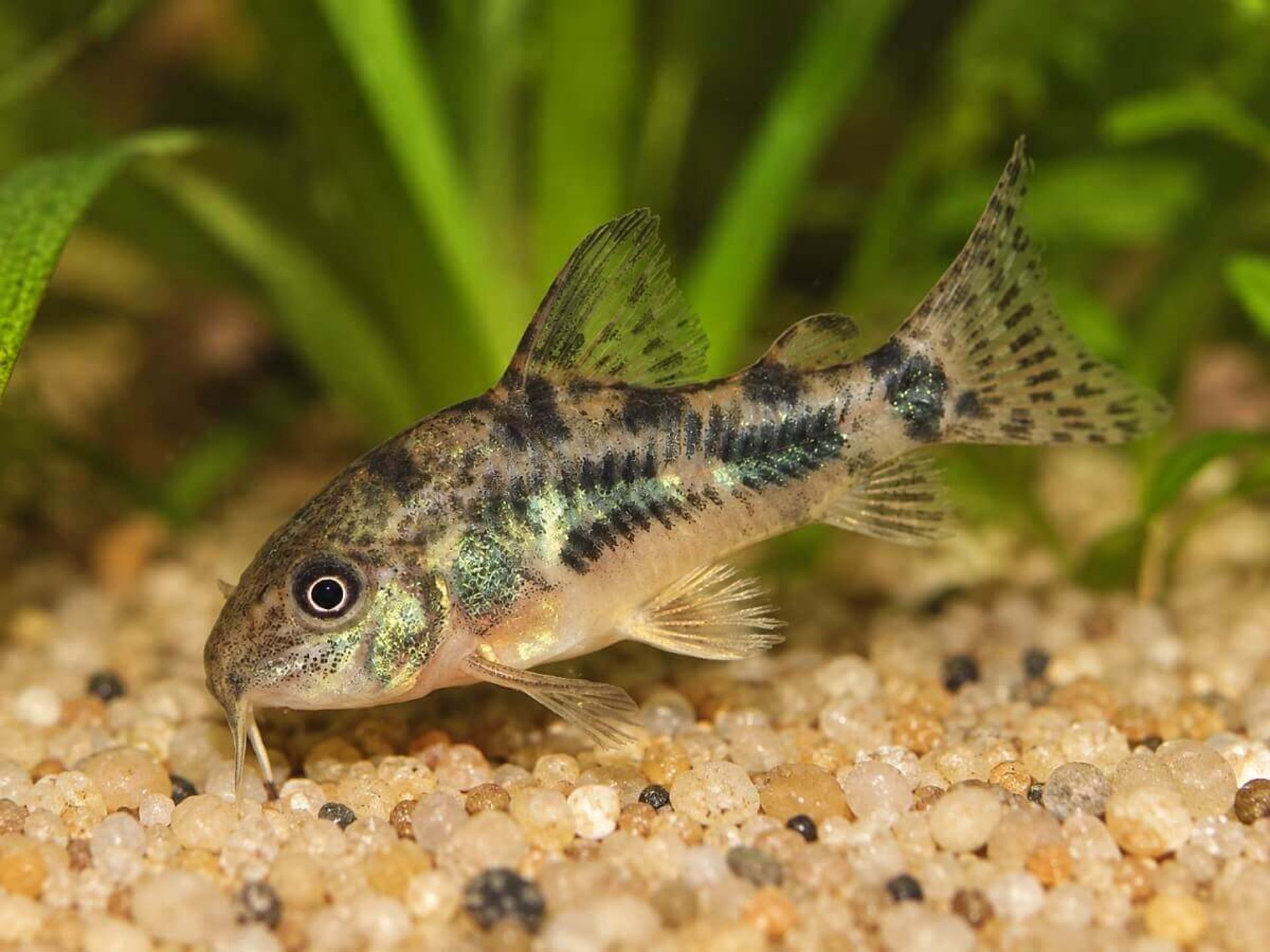
Spotted catfish (Corydoras paleatus, more recent Hoplisoma paleatum) is among the most popular aquarium fish living on the bottom. It is peaceful, social, interesting to observe, and under the right conditions, relatively easy to keep. Although it is often referred to as the "cleaner of the aquarium," it requires its own quality food and definitely does not replace regular maintenance of the tank bottom.
Spotted catfish in a nutshell
- Czech name: spotted catfish
- Traditional scientific name: Corydoras paleatus
- More recent scientific classification: Hoplisoma paleatum
- Origin: southeastern part of South America
- Size: approximately 6–7 cm
- Behavior: peaceful, social
- Recommended number: at least 5–6 individuals
- Position in the aquarium: primarily bottom
- Food: omnivore
- Suitable substrate: fine sand or smooth fine gravel
- Suitable for beginners: yes
What does the spotted catfish look like?
The spotted catfish is easily recognizable by its grayish to brownish body with irregular dark spots. The coloration of individual fish may vary slightly.
A characteristic feature of catfish are two rows of solid bony plates along the sides of the body. These provide them with protection and gave the entire group the Czech designation "catfish."
Around the mouth, they have sensitive whiskers, which they use to search the substrate for food. This is why it is important to choose a suitable bottom without sharp edges.
Is the spotted catfish suitable for beginners?
Yes. The spotted catfish is generally considered to be a relatively hardy fish that is well suited for a first community aquarium.
However, this does not mean that it can live in any conditions. Like other fish, it requires stable water quality, appropriate feeding, enough space, and especially the company of its own kind.
One of the most common mistakes of beginners is acquiring a single catfish as a "bottom cleaning fish." Catfish are social fish and thrive significantly better in groups.
How many catfish should be kept together?
The spotted catfish should not be kept alone. Ideally, a group of at least 5 to 6 individuals, and in a sufficiently large aquarium, even more.
In a group, catfish:
- are more active,
- are less shy,
- move around the tank more,
- exhibit naturally social behavior.
It is very interesting to observe several catfish as they search the bottom together or rest next to each other under a root or among plants.
How large an aquarium does the spotted catfish need?
For a smaller group of catfish, an aquarium with a length of at least around 60 cm is suitable.
For these fish, the most important factor is not the height of the tank, but primarily a sufficiently large bottom area. They spend most of their time on it.
A suitable aquarium should offer a combination of:
- open areas for foraging,
- fine substrate,
- plants,
- roots,
- rocks without sharp edges,
- calm places for resting.
Catfish are well suited for a classic community aquarium with peaceful species of similar requirements.
What type of substrate is best for catfish?
The ideal substrate is fine aquarium sand.
Catfish bury their mouths and whiskers in the substrate while foraging. Fine sand allows them to exhibit their natural behavior while minimizing the risk of injuring their sensitive whiskers.
A fine smooth substrate without sharp edges can also be used.
On the other hand, very coarse or sharp gravel is unsuitable.
It is also important to maintain the cleanliness of the substrate. A long-neglected substrate can contribute to the injury or infection of the whiskers when combined with unsuitable conditions.
Is the catfish really a "cleaner of the aquarium"?
Only partially. Catfish constantly search the bottom and can find small food remnants that other fish have overlooked. This allows them to help utilize some of the food that has sunk to the bottom. However, they are not a substitute for aquarium maintenance.
The catfish does not produce waste or dirt and will not clean the aquarium for you.
What should the spotted catfish be fed?
The spotted catfish is an omnivore and requires its own regular and varied diet.
The basis can be quality:
- sinking pellets,
- tablets for bottom-dwelling fish,
- quality wafers,
- frozen food,
- live food.
As a supplement, you can use, for example, brine shrimp, bloodworms, or other small live food suitable for aquarium fish. It cannotbe assumed that catfish will be satisfied with just the leftovers from feeding other fish.
In an aquarium with very active fish, it is even advisable to monitor whether a sufficient amount of food actually reaches the bottom.
Why does the catfish swim to the surface?
One of the most interesting behaviors of catfish is their quick trips from the bottom to the surface. The fish swims up, takes in air, and immediately returns. This is not necessarily a sign of oxygen deficiency.
Catfish also have the ability to utilize oxygen from atmospheric air. The swallowed air passes through their digestive tract, and they can absorb some of the oxygen through a specialized part of their intestine. Occasional trips to the surface are therefore completely normal.
However, if catfish start surfacing very frequently and their behavior suddenly changes, it is advisable to check:
- water quality,
- temperature,
- filtration,
- water current,
- oxygenation of the tank.
How is the spotted catfish kept?
Catfish are among the very peaceful fish. They spend most of the day searching the bottom. They alternate active foraging for food with short rests on the substrate, under roots, or among plants.
In a larger group, it is often possible to observe several individuals moving together. Although they are considered bottom fish, they are not strictly bound to the bottom. Occasionally, they make quick trips to higher water layers or even to the surface.
With which fish can catfish be kept?
The spotted catfish is especially suitable for a calm community aquarium.
It can work well with:
- smaller tetras,
- rasboras,
- some livebearers,
- calm barbs,
- other peaceful fish of similar size.
It is important to choose species with similar requirements for environment and water temperature.
Unsuitable companions are primarily very aggressive or highly territorial fish that could attack catfish or prevent them from accessing food.
The spotted catfish is not a armored catfish
Catfish are sometimes incorrectly referred to as armored catfish. However, they belong to a different group of catfish.
The spotted catfish belongs to the family Callichthyidae, while the well-known armored catfish, such as ancistrus, belong to the family Loricariidae. Although both groups often inhabit the bottom parts of the aquarium, their way of life, body structure, and diet differ.
Corydoras paleatus or Hoplisoma paleatum?
Experienced aquarists primarily know the spotted catfish under the name Corydoras paleatus. However, after a more recent taxonomic revision of catfish, this species has been reclassified into the genus Hoplisoma. The current scientific designation is therefore Hoplisoma paleatum.
In aquarium shops, literature, and on the internet, we will still encounter the older designation Corydoras paleatus for a long time. For breeders, of course, nothing changes – it is still the same spotted catfish.
Why acquire a spotted catfish?
The spotted catfish offers a combination of characteristics that have made it one of the classics of freshwater aquaristics.
It is peaceful, active, social, and well suited for a range of common community aquariums. While foraging, it constantly explores the bottom, making it very interesting to observe.
If you provide it with fine substrate, clean water, enough space, and a varied diet, it can be a long-term attractive inhabitant of the aquarium.