

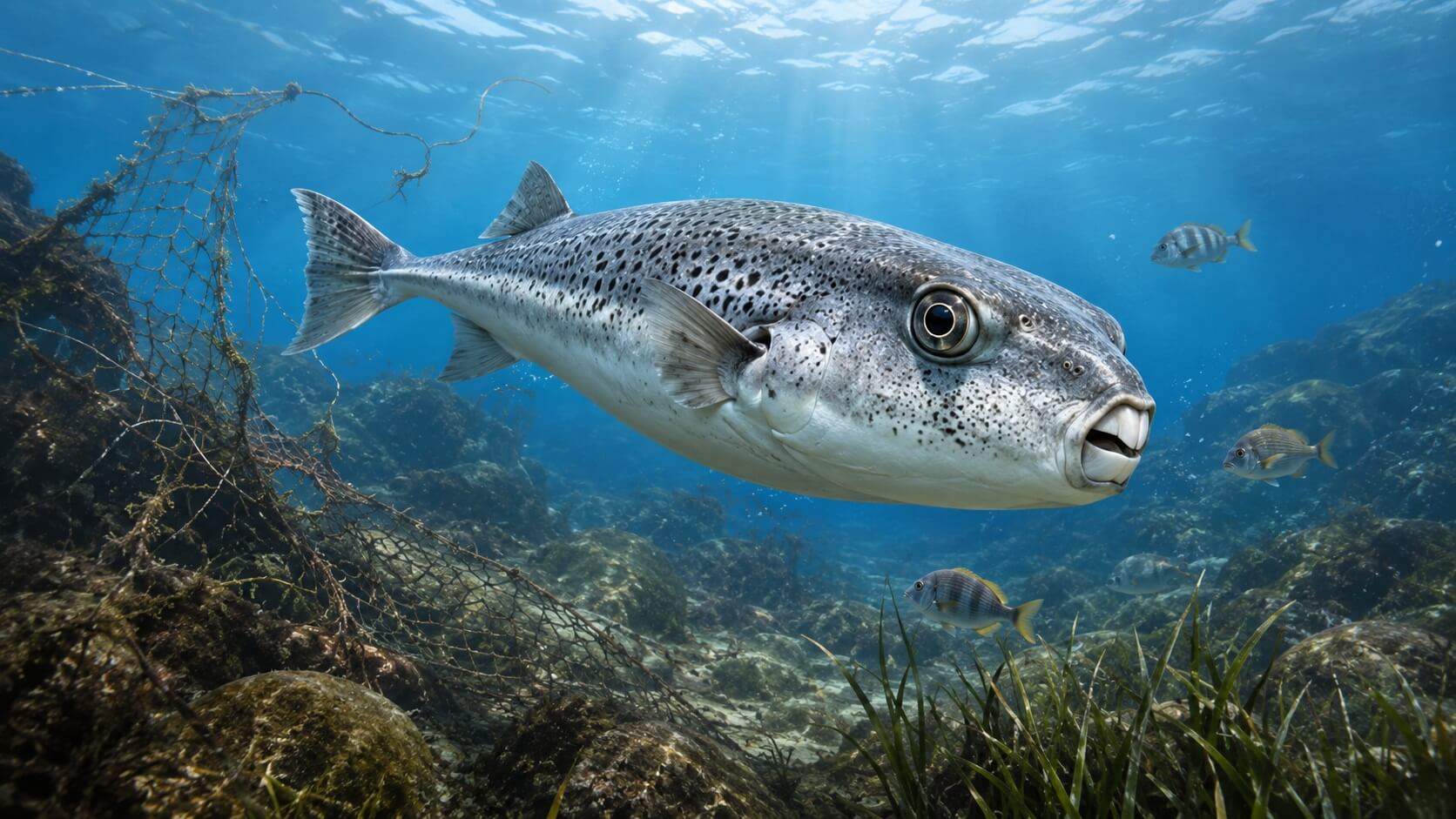
Pufferfish in the Mediterranean: Tropical invaders with dangerous toxins
Just a few decades ago, encountering a tropical pufferfish in the Mediterranean would have seemed like a biological curiosity. Today, some species are a permanent part of its eastern region and are gradually penetrating into the Adriatic Sea and the western Mediterranean. The silverstripe pufferfish attracts the most attention, as its invasion poses ecological, economic, and health problems.
Tropical pufferfish on the way through Suez
The silverstripe pufferfish (Lagocephalus sceleratus) originates from tropical and subtropical regions of the Indian and Pacific Oceans. It reached the Mediterranean from the Red Sea via the Suez Canal. The Suez Canal created a corridor between two originally separated marine areas, allowing hundreds of non-native organisms to spread into the Mediterranean. These include fish, mollusks, crustaceans, jellyfish, and algae. Not all can establish themselves permanently in the new environment, but the silverstripe pufferfish is among the exceptionally successful colonizers.
The first confirmed Mediterranean find of this species dates back to 2003 from the Turkish Gulf of Gökova. This was followed by rapid spread along the coasts of Turkey, Israel, Lebanon, Egypt, Cyprus, and Greece. Later, it was recorded in Tunisia, Malta, the Adriatic Sea, and even near Ceuta at the Strait of Gibraltar. CIESM currently assesses it as a very common species in the Mediterranean, especially in its eastern part.
A significant warning for European tourists and aquarists was the find in the Croatian bay of Medulin. A male measuring 52.2 centimeters and weighing 1.33 kilograms was caught here in May 2024. This was the northernmost confirmed find of the silverstripe pufferfish not only in the Adriatic but in the entire Mediterranean.
Warming seas facilitate further spread of the pufferfish
The Suez Canal itself opened a path for the fish, but their successful establishment also depends on conditions in the new environment. The Mediterranean is warming, and especially its eastern part increasingly resembles the subtropical regions of the Red Sea.
Higher temperatures prolong the period during which tropical species can reproduce and actively feed. At the same time, the temperature barrier that previously slowed their advance into the northern and western parts of the Mediterranean is diminishing. Rising temperatures promote the spread of non-native pufferfish and other warmth-loving fish, altering the species composition of coastal ecosystems.
The silverstripe pufferfish is also not a dietary specialist. It preys on crustaceans, mollusks, echinoderms, cephalopods, and smaller fish. It can move over sandy and rocky bottoms, around reefs, seagrass beds, and in harbor areas. Its eggs and larvae float freely in the water column, allowing ocean currents to transport them over considerable distances.
How to recognize the silverstripe pufferfish
The body of this fish is elongated in a resting state and tapers towards the tail. The head is robust, with a blunt snout and prominent eyes. The upper part of the body is grayish to silvery and covered with dark spots. A distinct light, silvery stripe runs along the sides, and the belly is white.
The dorsal and anal fins are positioned far back and are almost opposite each other. The pelvic fins are completely absent. A typical feature is also the four robust dental plates – two in the upper and two in the lower jaw. They form a beak that the fish easily uses to crush the shells of mollusks, the exoskeletons of crustaceans, fishing lines, and parts of nets.
When threatened, the pufferfish can quickly gulp water and significantly increase its body volume. Common individuals measure approximately 20 to 60 centimeters, and according to the CIESM atlas, they can reach lengths of up to around 85 centimeters.
Other non-native pufferfish species also appear in the Mediterranean, such as Lagocephalus suezensis* or *Lagocephalus guentheri. However, the silverstripe pufferfish is considered the most problematic due to its size, rapid spread, feeding behavior, and high toxicity.
Deadly danger hidden in the body
The most serious risk is tetrodotoxin, an extraordinarily potent neurotoxin that can be found in the liver, reproductive organs, intestines, skin, and muscle tissue of the fish. Its quantity varies among individual specimens, organs, seasons, and locations. Therefore, there is no part of the Mediterranean pufferfish that can be considered safe to eat.
Tetrodotoxin blocks sodium channels in nerve and muscle cells. The first symptoms of poisoning are often tingling or numbness of the lips and tongue, nausea, vomiting, dizziness, and muscle weakness. Severe poisoning progresses to total paralysis and respiratory failure, while the affected person may remain conscious.
The toxin is heat-stable. Common cooking, frying, drying, or freezing does not reliably destroy it. There is also no specific antidote for poisoning, and treatment mainly consists of intensive supportive care and artificial ventilation until the organism eliminates the toxin.
European regulations therefore prohibit the marketing of products derived from toxic fish of the Tetraodontidae family. The fish cannot be considered the Mediterranean equivalent of the Japanese fugu, which could be safely prepared merely by removing the internal organs.
A study published in 2024 collected at least 144 cases of non-fatal poisoning and 27 deaths from pufferfish consumption in the eastern Mediterranean between 2004 and 2023. The authors also recorded 28 cases of physical attacks or bites. The data comes from scientific literature, medical reports, interviews, and other records, and the actual number of incidents may vary.
Not only toxins are dangerous
The pufferfish is not poisonous in the sense of an animal that actively injects toxin through a sting or spine. Simply swimming near it generally does not pose an immediate danger. The risk arises primarily from consumption or very close contact.
However, its powerful teeth can cause deep wounds. Documented cases of bites have primarily involved fishermen, people handling catches, and bathers who approached the fish, attempted to feed it, or found themselves in its immediate vicinity. Attacks on humans remain less frequent compared to the risk of poisoning, but they cannot be entirely ignored.
A predator that alters food relationships
An invasive species is not dangerous solely because it is toxic. What is essential is how it affects native communities. The silverstripe pufferfish is a strong and adaptable predator that consumes economically and ecologically significant crustaceans, mollusks, and fish.
It can thus reduce the abundance of certain species and alter relationships in food chains. In its new environment, it also has a limited number of natural enemies. Its toxicity, size, and ability to quickly occupy various types of habitats give it a significant advantage.
Here it is important to distinguish between non-native and invasive species. A non-native organism does not automatically cause harm. It is considered invasive when it successfully reproduces in a new environment, spreads rapidly, and has demonstrable negative impacts. The silverstripe pufferfish meets these criteria in the eastern Mediterranean.
The pufferfish is a disaster for fishermen too
The economic damage is very visible. Pufferfish chew through fishing lines, damage nets, and remove caught fish from them. The catch can be spoiled before the fisherman hauls it aboard. Since the pufferfish itself cannot be sold as food, its accidental catch represents additional work and costs without economic benefit.
Greek fishermen report damages to nets reaching thousands of euros per year for individual boats. Cyprus and, more recently, Greece have therefore introduced a program in which professional fishermen are financially rewarded (in Greece 5.33 euros/kg) for targeted catches and handing over pufferfish for safe disposal. European projects are also exploring the possibilities of industrial processing of the fish into feed ingredients, but only under conditions where the toxin is professionally deactivated.
What to do when encountering a pufferfish
When diving or snorkeling, it is advisable to observe the fish from a distance. It is not good to feed it, chase it into hiding, or attempt to catch it. Photographing from a safe distance can help document its further spread.
Fishermen should not taste, fillet, or give the catch to pets. When handling, one must primarily account for a quick and strong bite. The method of reporting, killing, or handing over the fish varies in different Mediterranean countries, so it is advisable to follow the guidelines of local fishing and veterinary authorities.
After a bite, it is necessary to stop the bleeding, clean the wound, and seek medical attention. If there is suspicion of pufferfish ingestion or the first neurological symptoms appear, emergency services should be contacted immediately. Waiting for spontaneous improvement can be life-threatening in cases of tetrodotoxin poisoning.
An attractive fish that does not belong in a home aquarium
For aquarists, the pufferfish can be fascinating due to its anatomy, intelligence, and unusual defense mechanism. However, the silverstripe pufferfish is definitely not a suitable candidate for a typical home marine aquarium.
It grows to a considerable size, is an active predator, possesses an extraordinarily strong dentition, and can attack other organisms and the technical equipment of the tank. Handling a large specimen poses a risk of injury, and any potential death creates a problem for the safe disposal of the toxic body. Therefore, live individuals should not be caught or transported from the wild.
A new reality of the Mediterranean Sea
The complete removal of the silverstripe pufferfish from the Mediterranean is likely no longer realistic. The species is spread over too large an area and has established stable populations in many regions. However, targeted catches, monitoring of new finds, informing fishermen and the public, and strict control of fish sales make sense.
The story of the pufferfish also illustrates how quickly seemingly familiar marine ecosystems can change. The combination of artificially created migration routes, intensive shipping traffic, and warming waters allows tropical species to move further north. A fish that was almost unknown in the Mediterranean at the beginning of this century is now one of the most prominent symbols of biological invasion in European seas.